MAP: All 23 industrial warehouses ICE wants to turn into detention ‘death camps’
By Camaron Stevenson, Below the Belt(way)
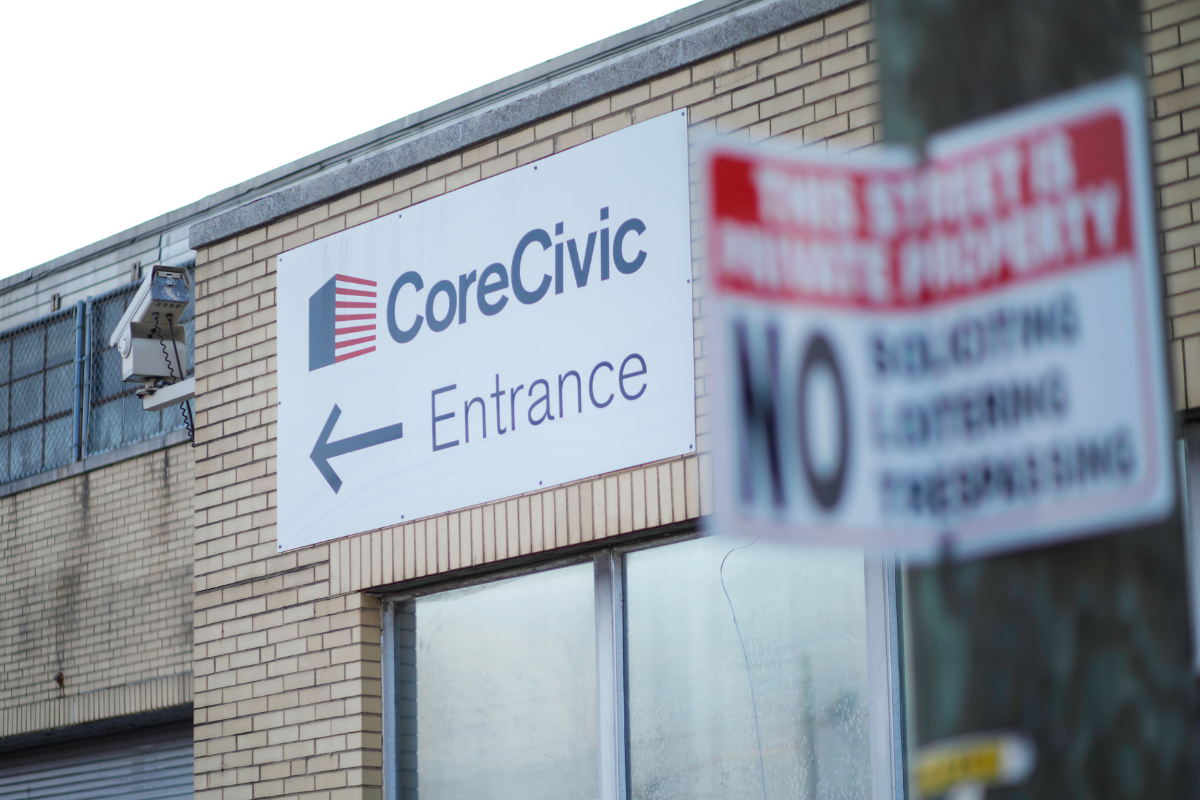
Plans are underway to double the detention capacity of the Trump administration’s federal police force by converting massive, industrial warehouses unsuitable for people to live in into detention centers.
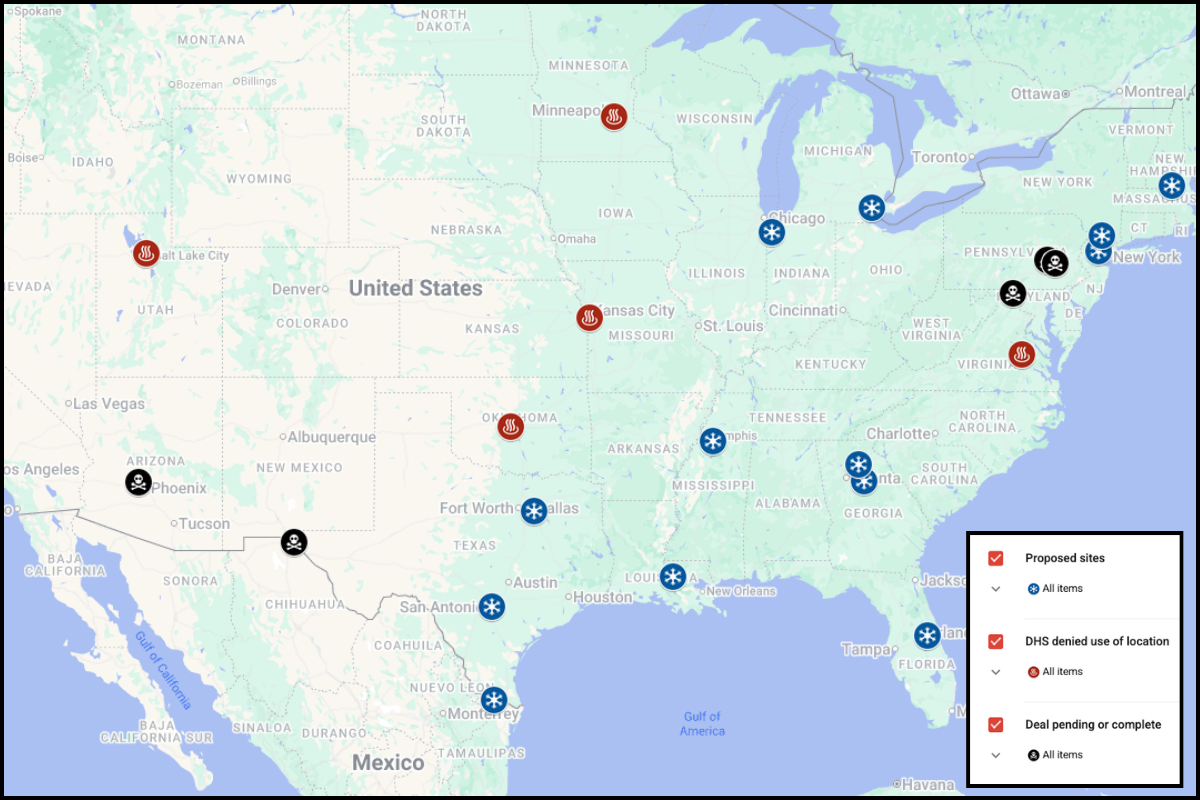
COURIER has independently verified the location of 23 mass detention campsites that have been surveyed by the US Immigration and Customs Enforcement. Of those locations, leases for five have been secured, while opposition from local communities has killed or stalled deals at five others.
In an apparent attempt to avoid public outcry and scrutiny, ICE has sought to secure these leases in private, ignoring potential health and safety violations and catching local elected officials off guard. In an effort to provide transparency into this process, we have published a searchable map showing each proposed site, its current status, and the level of public response.
All 23 locations can be found here.
Got a tip on another proposed detention site, or have photos from a recent protest you’d like to share? Send them to camaron@couriernewsroom.com
The facilities fall into four categories: signed leases, stalled by community efforts, opposed by community, and preliminary stages.
Signed Leases: Arizona, Maryland, Pennsylvania, Texas
Leases have been signed or otherwise confirmed by local officials in Surprise, Arizona; Williamsport, Maryland; Tremont, Pennsylvania; Hamburg, Pennsylvania; and Clint, Texas.
In Arizona, residents and city officials were caught completely off guard by the government’s $70 million purchase of a warehouse ICE plans to fill with 1,500 people. Reporting by the Washington Post listed Glendale, Arizona, as its location, but a review by COURIER found that DHS has listed the city incorrectly in its own internal documents.
“If they are going to house people there, it is a death camp. I don’t say that lightly,” said Arizona Sen. Analise Ortiz. “This is abhorrent and chilling because ICE is already violating the US Constitution, which means none of us are safe, including US citizens.”
DHS spent another $102 million to purchase a warehouse in Maryland, despite near-constant protests from surrounding communities.
“In blatant disregard for the will of this community, Trump’s ICE has spent over $100 million for a massive warehouse prison to hold up to 1,500 detainees,” US Sen. Chris Van Hollen said while at a protest. “This Administration is spitting in the face of communities from Minneapolis to Maryland and wasting our tax dollars. We won’t stop fighting back.”
Subscribe to Below the Belt(way)
Stalled by Community Efforts: Minnesota, Missouri, Oklahoma, Utah, Virginia
In five states, proposed warehouse purchases have been halted by successful community opposition in distinctly different ways.
After a monthslong murderous occupation of their state by ICE, Minnesotan’s reaction to news of a potential detention camp was visceral. Protests erupted in the city of Shakopee almost immediately after DHS’s intentions became public. City, state, and federal officials all came out in unequivocal opposition. The warehouse owner announced it rejected DHS’ offer shortly after word got out.
“It’s not often these days that we get good news this fast, but that’s the power of community here in Shakopee,” Minnesota Rep. Brad Tabke told Bring Me The News. “I’m so incredibly proud of all our neighbors who took up the call in such a short amount of time to let it be known that ICE in Shakopee is not OK.”
Proactive sleuthing by Jackson County Legislative Chair Manny Abarca brought national attention to ICE’s plans to create a warehouse prison camp for over 7,000 people in Kansas City, Missouri. Despite not being alerted to the plans by ICE, Abarca got word that they would be touring the publicly-owned facility in mid-January.
So he went.
“I parked one car length away in the second row of parking spots facing the building, and just watched from my truck. I didn’t get out, just parked,” said Abarca. “Immediately, two cars came from the front, two cars came from the back, and boxed me in. These are unmarked vehicles, these are not ICE vehicles. These are, what looked like, personal vehicles, because they had personal tags. And to me, that was intimidating, right? That was an intimidation tactic. Then two ICE agents in tactical gear got out.”
The agents falsely claimed Abarca was trespassing and told him to leave — even though he couldn’t because they had boxed him in. After a short back-and-forth, Abarca called local news affiliates and told them about the situation. Reporters rushed to the scene, followed by anti-ICE protestors, and the incident garnered national attention.
“Had they not been there, Lord knows what would have happened to me,” Abarca said. “This is a performance, sadly, when you come to think about ICE and their reaction to me. Do they want to drag me out of the car and beat me up on the floor? No, not in front of the cameras.”
Abarca used this momentum and the support from his constituents to pass a five-year, countywide moratorium on the opening of any non-municipal detention center.
In Salt Lake City, a combination of public pressure and bureaucratic maneuvering was enough to kill a deal between DHS and The Ritchie Group, a local development firm that owns the warehouse ICE wanted.
SLC residents picketed outside the site and Mayor Erin Mendenhall told The Ritchie Group their facility did not meet city code for ICE’s desired purposes. Less than a week after protests began, the real estate group put out a public statement telling DHS there would be no deal.
“The Ritchie Group is proud to be a family-owned Utah business that has been building our communities since 1973,” they said. “The Ritchie Group and its investors have no plans to sell or lease the property in question to the federal government.”
A similar outcome unfolded in Virginia. After days of protests, hours of statements in opposition at local council meetings, and a unanimous resolution against the detention center by the Hanover County Board of Supervisors, the warehouse owners said the deal between them and DHS was dead.
Opposed by Community: Florida, Georgia, Indiana, Michigan, Mississippi, New Hampshire, New Jersey, New York, Texas
Opposition to erecting concentration camp-styled warehouse detention centers has been universal. US Rep. Pat Ryan (D-NY) collected 10,000 signatures in Chester, a town of just 12,000 residents, in opposition to a proposed ICE warehouse, and US Sen. Jon Ossoff (D-GA) launched an inquiry into DHS and ICE over their failure to consult the town of Social Circle before advancing a similar plan.
“A proposed ICE detention facility is not right for Social Circle, and the City of Social Circle does not support it,” Ossoff and Social Circle Mayor David Keener said in a joint statement. “We are urging the Administration to abandon this plan, which risks overwhelming the City’s resources and more than tripling its population.”
Like most sites selected by ICE, Social Circle lacks the infrastructure needed to provide suitable living conditions for the amount of people the Trump administration wishes to fill the warehouses with. An inability to provide adequate water, electricity, sewage, and other basic necessities would create inhumane living conditions for hundreds of thousands of people.
Such conditions are well-documented. An Amnesty International investigation into prototype detention camps in Florida found that the Trump-endorsed facilities kept detainees shackled in overcrowded cages, underfed, forced to use open-air toilets that routinely flooded while being regularly denied medical care. Other ICE-run detention camps are rampant with sexual assault, sexual extortion by ICE agents, negligent deaths, and at least one reported homocide.
These inhumane conditions have also brought local opposition to proposed warehouses in Hutchins, Texas; Orlando, Florida; Roxbury, New Jersey; Merrillville, Indiana; and Merrimack, New Hampshire.
Preliminary Stages: Georgia, Louisiana, Michigan, Mississippi, Texas
Five sites identified internally by ICE remain in early stages, with little public disclosure and no formal notification to local leaders.
A number of officials have voiced opposition, but stopped short of taking any preventative action. Some, like the county supervisors in Hanover, said they were ultimately hamstrung by the federal government, who they believe have the ultimate authority should they wish to proceed. Others, like Abarca, reject this mentality, and believe alternative measures must be taken to ensure the will of the people is the final authority.
‘At some point, we won’t be able to stop them from buying that building and attempting to open it. However, if I decide to divert the river on the south side of that property and create a moat, they might have to build a bridge,” said Abarca. “There are ways that local governments can react — if we’re willing to do it.”
Subscribe to Below the Belt(way)
Correction: A previous version of this story incorrectly labeled the warehouse in Roxbury, New Jersey.