SCOOP: Trump’s DOJ never investigated Epstein’s alleged money laundering businesses

By Camaron Stevenson, Below the Belt(way)
Billions of dollars in suspicious transactions flowed through sex trafficking kingpin Jeffrey Epstein’s financial accounts at the height of his influence. Yet federal law enforcement never searched his business officers, seized his records, or even questioned his accountant.
An ongoing investigation by COURIER into the individuals connected to Epstein’s criminal ring who have not faced charges uncovered internal FBI correspondence confirming that agents never searched Epstein’s businesses suspected of money laundering.
“It’s never been reported whether his business office in St Thomas, in the American Yacht Club was searched. We have talked to a merchant in the marina/office complex,” New York Times reporter Matthew Goldstein wrote in an October 2019 email. “Can you confirm the search for us on Aug. 12 or if that date is error, that the office was search [sic] by your agents.”
Minutes after receiving the email, agents confirmed internally that no such search had taken place. But it took more than a month — and pressure from Goldstein — for the FBI to respond that they couldn’t comment on an ongoing investigation.
Goldstein also asked about garbage bags of shredded paper allegedly found outside Epstein’s Southern Trust offices weeks before Epstein’s arrest, but it never ended up being reported on. COURIER reached out to Goldstein, who confirmed the correspondence, and said he lacked enough credible sourcing to report it at the time.
Whether the FBI searched the offices after the November 2019 exchange remains unclear. COURIER reached out to the FBI agent assigned to the case at the time, who did not respond to a request for comment.
However, depositions released Thursday by the US House Oversight Committee suggest that any search of Epstein’s offices — by the FBI or the six other federal agencies that were investigating him — would have been extremely unlikely.
The depositions, taken in mid-March and released Tuesday, include testimony from Darren Indyke and Richard Kahn, the longtime attorney and accountant Epstein named as executors of his estate. The depositions were part of a congressional investigation into the US Justice Department’s now-closed case into Epstein’s international sex trafficking operation.
Both Kahn and Indyke admitted for the first time that no federal agent or law enforcement officer had ever questioned either of them in relation to Epstein’s crimes.
“I’ve never been questioned by any government authority,” Khan said bluntly, when asked by Billy Grant, the Oversight committee’s deputy chief counsel.
“The answer is no. I don’t believe I have,” Indyke responded similarly. “Personally, no. I know that over the last several months, the estate has provided information to the Justice Department.”
The combined 13 hours of testimony from Kahn and Indyke paint a detailed picture of the duo’s intimate involvement with every aspect of Epstein’s financial affairs. Indyke created numerous LLCs and business holdings, withdrew hundreds of thousands of dollars in cash, and handled paperwork for his many investments; Khan worked directly with banks, even impersonating Epstein at times, and facilitated fraudulent marriages involving some of his victims.
An interrogation of Kahn and Indyke would be standard procedure in any financial crimes investigation, had such an investigation taken place. Epstein’s financial documents are replete with both men’s signatures, and suspicious activity reports and “know-your-customer” checks — both required when a client is suspected of money laundering or human trafficking — filed by banks listed the three men as equals within Epstein’s financial empire.
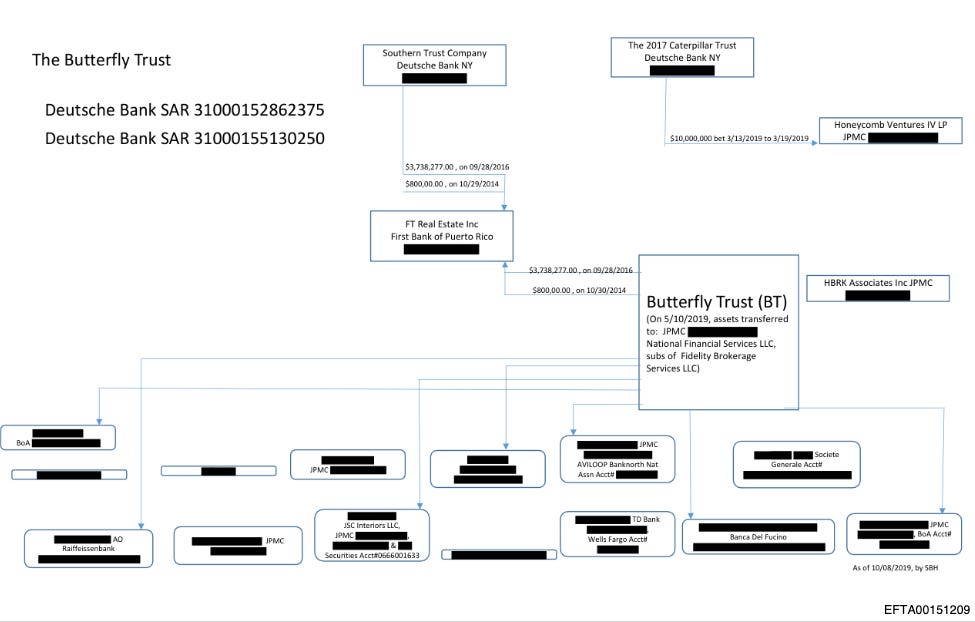
Thousands of suspicious transactions worth billions of dollars are tied directly to Kahn and Indyke through Epstein. They include businesses like Southern Trust, Butterfly Trust, and other entities authorities believe helped facilitate money laundering, human trafficking, and other fraudulent activity, but appear to have never been seriously investigated. And while some of the banks used by Epstein have paid hundreds of millions in civil settlements, there has still never been any substantive criminal investigation to determine wrongdoing.
US Rep. Summer Lee (D-PA), a ranking member of the Oversight Committee, said the apparently intentional omission of financial scrutiny reflects a broader institutional failure by the Trump administration and private sector alike to sacrifice justice at the hands of profit.
“This is reaffirming all of the distrust that Americans have. It has felt like, from the beginning, from all of the various investigations that have actually taken place around Epstein, if you look at every step of the way, there has been collusion, has been what looks like conspiracy, there’s been hidden information,” said Lee. “We’re talking about banks. We’re talking about businesses. All of these in some way have failed, and allowed Epstein to have been able to do what he was able to do with as many people who had who knew it. It proves a deep distrust of why Americans do not believe that we have an equal justice system in this country.”
On March 17, Lee introduced articles of impeachment against US Attorney Pam Bondi, citing her role in the apparent coverup of Epstein’s criminal ring of financial fraud and sexual abuse. Bondi has repeatedly been defended by Trump — who is himself implicated in the Epstein Files — and has thus far avoided any serious scrutiny.
Lee believes that meaningful accountability for Epstein’s accomplices and co-conspirators will not be possible until Bondi is removed from her post.
While that may appear impossible with a Republican-controlled Congress — House Oversight Chair US Rep. James Comer (R-KY) held a “sham” deposition for Bondi recently, where she was neither under oath nor required to provide information — Lee views public pressure as a realistic path toward impeachment, and by extension, removing one of the main barriers to justice for Epstein’s victims and consequences for his enablers.
“We saw, even without articles of impeachment, Kristi Noem does not exist anymore. We need public pressure right now on this administration, from Americans of all stripes, who do not believe that she should continue to stay in this role. We’ve seen how that pressure worked to get the same files that we do have,” said Lee. “That’s why they are nervous, because they’re recognizing that they can’t run away from this one anymore. Between the outside pressure, between these articles that we will be pushing on the inside, and then the subpoena that [Bondi] says she may or may not answer… Those will all be pressure points that we will put on her to do the right thing, for Trump to do the right thing, or for Congress to have the opportunity to take action.”