The Religion Story Missing From Election Coverage
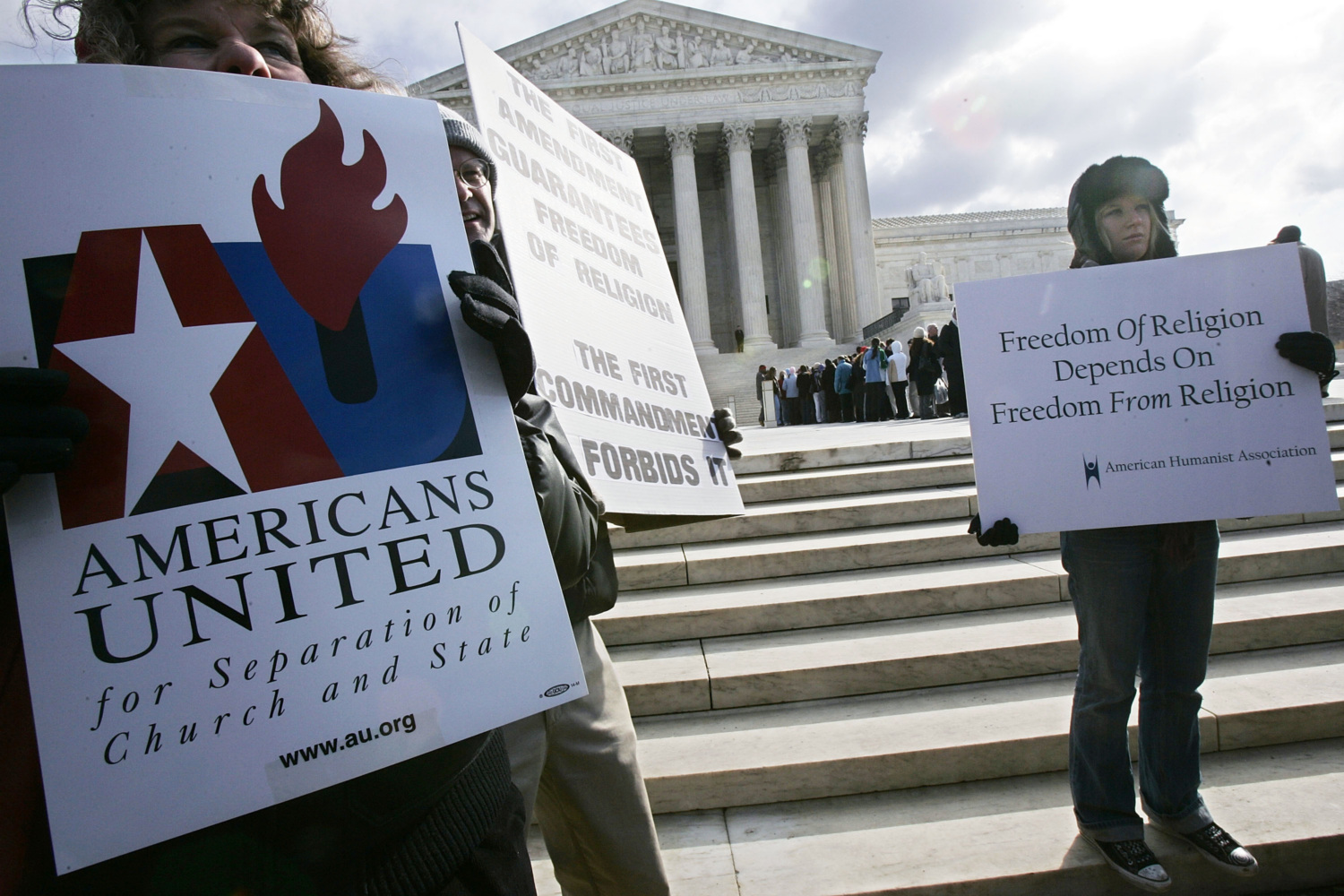
Alex Wong/Getty Images
By Rachel Laser
Hello! I’m Rachel Laser, president and CEO of Americans United for Separation of Church and State — the only organization dedicated solely to defending the separation of church and state as the shield that protects the foundational American principle of religious freedom for all.
For nearly 80 years, AU has brought together people of all religions and none to protect everyone’s freedom to live as themselves and believe as they choose – and stop anyone from using their beliefs to harm others. We fight in the courts, legislatures, and the public square for freedom without favor and equality without exception.
Today, I explain why it’s a problem that church-state separation — and threats to this constitutional promise — weren’t a bigger part of the national conversation during the recent midterm elections.
More on that below, but first…
Religion played a prominent role in several races this election cycle. In Michigan, U.S. Senator-elect Abdul El-Sayed faced anti-Muslim rhetoric. There were efforts to cast doubt on the Christian faith of U.S. Senators-elect James Talarico in Texas and the Rev. Adam Hamilton in Kansas. Iowa Governor-elect Rob Sand came under scrutiny over his progressive church. But what received far too little attention was church-state separation – the foundational American principle that guarantees our right to run for public office regardless of our religious beliefs and prevents us from abusing that office to impose our beliefs on others.
According to a recent national poll funded by my organization, Americans United for Separation of Church and State, 86% of voters say that church-state separation is important, but only 30% believe it’s under very serious threat. That gap is alarming, especially given the flagrant attacks on this principle at every level of government.
After traveling the country for nearly 9 years talking about this topic, I have a sense of why this discrepancy exists: Many of us don’t understand what church-state separation is really about or how profoundly it shapes our daily lives. So let’s start there.
America’s founders enshrined church-state separation (shorthand for the separation of religion and government) in the Constitution because they understood it was essential to protecting religious freedom for all. And they meant all. Thomas Jefferson described that freedom as extending to Christians, Jews, Muslims, Hindus, and even the “infidel of every denomination” – a radical idea for the late 1700s.
Church-state separation isn’t anti-religion or anti-Christian. Quite the opposite: Keeping religion and government separate enables religion to thrive in America. It’s what allows Muslims like El-Sayed and Christians like Talarico and Jews like me – as well as atheists, Hindus, Buddhists, and so many others – to participate fully in our society. It’s what allows us not just to believe as we choose, but also to live as ourselves, love who we love, and make decisions about our reproductive lives according to our own beliefs.
At least, that’s the promise. But that promise is under siege.
A political ideology known as white Christian Nationalism is threatening our American experiment, 250 years after it began. The movement seeks to use the power of the government to force everyone to live according to one narrow set of religious beliefs.
These extremists promote the false idea that America was founded as a Christian nation and therefore must grant privilege and preference to conservative white Christians. They are trying to impose their religious views on public school students and government workers, strip away reproductive freedom, dismantle diversity, equity, and inclusion efforts, whitewash our history, and roll back civil rights protections for women and Black, brown, LGBTQ+, and other historically marginalized people.
This movement counts some of the nation’s most powerful government officials among its supporters, including many within the Trump administration’s cabinet and advisory boards. At Turning Point USA’s annual conference, Vice President J.D. Vance drew some of the loudest applause when he declared: “The only thing that has truly served as an anchor of the United States of America is that we have been, and by the grace of God, we always will be, a Christian nation.” He soon added: “Christianity is America’s creed.”
Texas Lt. Gov. Dan Patrick, the chair of Trump’s so-called Religious Liberty Commission, lost his reelection bid this month. Earlier this year, he called church-state separation the “biggest lie that’s been told in America since our founding.” In June, his commission released a draft report proposing to turn Jefferson’s wall between church and state into a “bridge.”
The administration isn’t just laying the groundwork for this metaphorical bridge. It’s already crossing it.
The Departments of Defense and Labor, along with the Small Business Administration, have conducted regular prayer services featuring almost exclusively Christian speakers like Pastor Doug Wilson, a self-described “theocratic libertarian” who thinks the 19th Amendment granting women the right to vote was a “bad idea.”
At the Department of Agriculture, Secretary Brooke Rollins has used her access to some 100,000 federal employees to send a steady stream of religious messages, including this one on Easter: “Happy Easter – He is Risen indeed! … Today we celebrate …the foundation of our faith, and the abiding hope of all mankind … Jesus has been raised from the dead.” Though Rollins sent her Easter sermon during Passover, she didn’t acknowledge the Jewish holiday.
Many states are crossing that church-state bridge too – especially when it comes to public education. Alabama, Arkansas, Louisiana, Tennessee, and Texas have enacted laws either requiring or encouraging Ten Commandments displays in public school classrooms. Nearly 20 other states have considered similar legislation over the past two years.
My organization and our allies are waiting to hear if the U.S. Supreme Court will hear our challenge to Texas’ Ten Commandments mandate. We’re urging the justices to reaffirm a basic principle: Parents and families – not politicians – get to decide if, when, and how children engage with religious scripture.
This election cycle offered plenty of examples of religion being used to question a candidate’s fitness for office. But the threat of Christian Nationalism and the importance of church-state separation were largely missing from the conversation.
Rather than treating candidates’ personal faith as the issue, we should have been focusing on this principle as a foundation of our freedom and a unifying force that protects us across our different beliefs. Every candidate should have had to reject Christian Nationalism and pledge to represent all of their constituents, including those who don’t share their faith.
In America, the question should never be whether our leaders share our religious beliefs. It should be whether they will defend the freedom of every one of us to live according to our own.