House Closes Door on New Leadership. Will the Senate?
By Camaron Stevenson
What Happened
The incoming Democratic-controlled Congress has big plans to tackle corruption in the Trump administration and cut costs. But voters aren’t convinced the current leadership is up for the job.
Almost immediately after the midterm results became clear, the nationwide grassroots organization Indivisible called on the new Congress to elect new leaders, arguing that Rep. Hakeem Jeffries (D-NY) and Sen. Chuck Schumer (D-NY) were both too emblematic of the old, “do-nothing Congress” to meet the moment. Critics across the political spectrum joined in, accusing Jeffries and Schumer of being too beholden to corporate donors to take on corruption, too intertwined with the medical industry to tackle healthcare costs, and too bound to AIPAC to end the Iran War or stop the ongoing genocide in Palestine.
“Any Democrat who is considering business as usual, or unwilling to fight at a level that matches the public’s demand for action – is not qualified to lead the party at this moment,” Indivisible sent in a memo to its members after the election. “Who leads the party in this era must be an open question, not a coronation.”
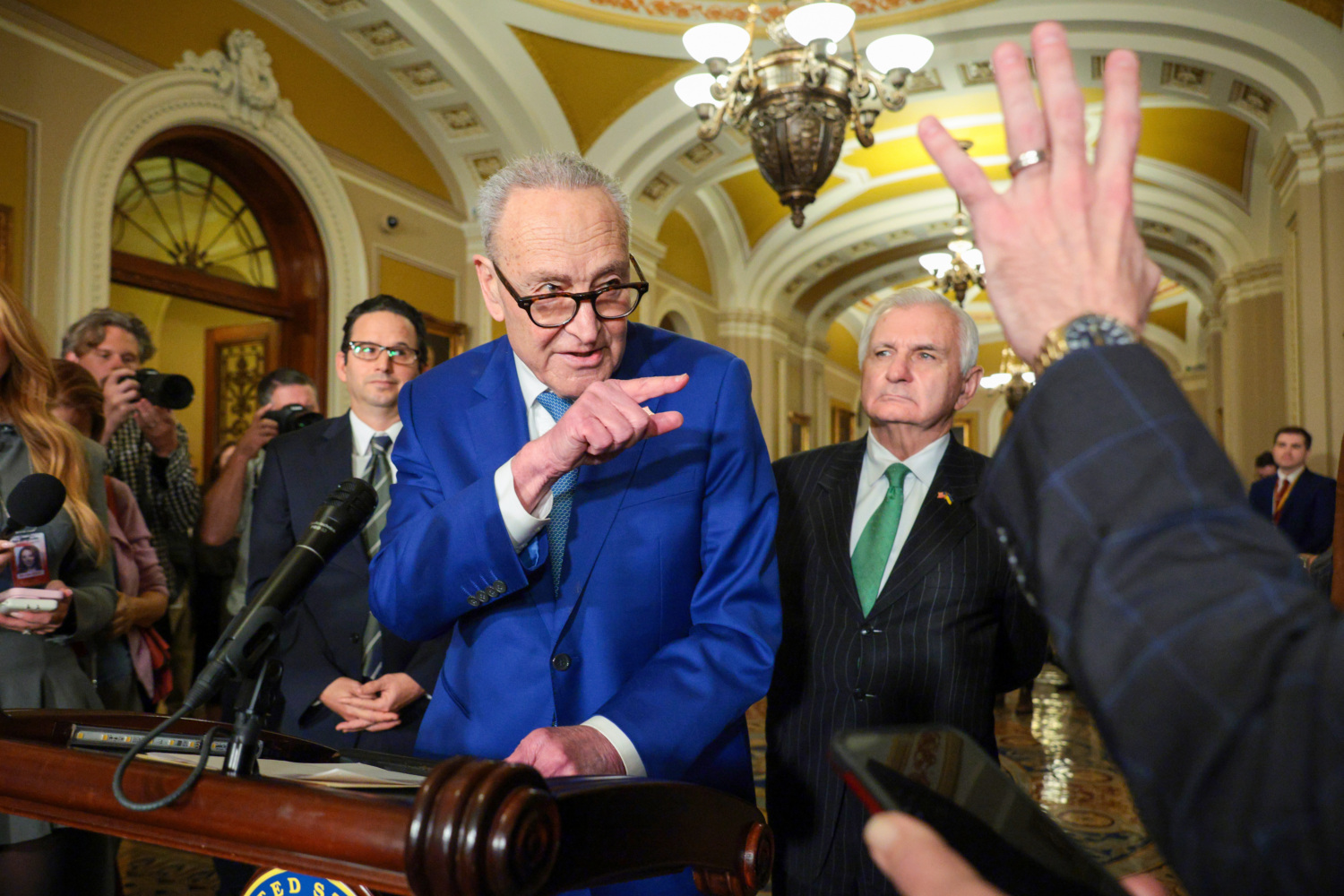
While Schumer’s Senate colleagues seem open to the idea of a new Majority Leader, Jeffries has secured the near-universal support of House Democrats, all but guaranteeing his role as the next Speaker of the House. Here’s where both chambers stand:
The Senate
Schumer is facing a challenge from Sen. Chris Van Hollen (D-MD) for the role of Senate Majority Leader. Van Hollen entered the national spotlight in 2025, when he traveled to El Salvador to negotiate the return of Maryland resident Kilmar Abrego Garcia, who was illegally abducted by the Trump administration and sent to a Central American supermax prison.
While Van Hollen is only eight years younger than Schumer, progressive leaders see him as a relatively fresh face who has stood firm in his values in the face of violent authoritarians, both at home and abroad. Schumer, on the other hand, has developed a reputation for blowing over from the slightest breeze of opposition, favoring compromise at a time when voters are demanding resolve.
“In this election, the American people called for change. They called for a change from Donald Trump’s disastrous policies – but even bigger than that, a change from the status quo that isn’t working for working people,” Van Hollen said in a statement. “It’s now on us to meet this moment, and to do that we need new leadership. This is not about any one person – it’s about answering the call of the American people. That is why I’m running for Senate Majority Leader.”
Van Hollen faces an uphill battle in unseating his caucus’ leader of nearly a decade, but the climb may not be as steep as it first looked. 16 senators have come out in support of Schumer, and 12 have either said they wouldn’t vote for Schumer or pledged their support to Van Hollen. Van Hollen says he’s received verbal commitments from at least 15 senators — including several who previously backed Schumer. The winner will need a simple majority of 28 votes in order to secure victory.
At the time of publication, the following 27 senators remain uncommitted, or have not made their positions public:
Alaska: Mary Peltola
California: Adam Schiff, Alex Padilla
Colorado: John Hickenlooper, Michael Bennet
Connecticut: Chris Murphy
Delaware: Chris Coons, Lisa Blunt Rochester
Georgia: Jon Ossoff, Raphael Warnock
Illinois: Tammy Duckworth
Massachusetts: Ed Markey, Elizabeth Warren
Mississippi: Scott Colom
New Hampshire: Maggie Hassan
New Jersey: Andy Kim, Cory Booker
New Mexico: Ben Ray Luján, Martin Heinrich
North Carolina: Roy Cooper
Oregon: Ron Wyden
Texas: James Talarico
Vermont: Peter Welch
Virginia: Mark Warner, Tim Kaine
Washington: Maria Cantwell, Patty Murray
The vote is scheduled for Dec. 1, and senators are currently taking calls from constituents as they weigh their decision.
The House
Jeffries secured his party’s nomination for Speaker of the House on Wednesday, winning 95% of the vote in an uncontested race. The election won’t take place until the new Congress is seated in January, but by holding the nomination now, Jeffries effectively killed any attempt at an opposition movement that may have been sparked by Van Hollen’s challenge to Schumer.
“It’s an honor to be serving with a majority of 260 members from all across the country,” said Jeffries.“The overwhelming majority of people within the caucus have spoken, clearly and decisively, from all corners of the caucus, and I’m humbled by that. I think we all are humbled by that. But while we run to win, we win to govern, and we govern to get big things done and make life better for the American people. That’s our mission.”
After the vote, dozens of House Democrats spoke about their support for Jeffries, praising his ability to unite nearly the caucus behind his leadership. No one addressed — or was asked about — concerns regarding his donors or his ability to stand up to the Trump administration.
“The freshman class right now is a historically large class,” said Rep.-elect Dan Koh (D-MA). “I think it makes sense for a lot of them to want to say there’s things that their constituencies have demanded and they want to make sure they have the audience of the leader. I would give the leader credit: he has been taking a lot of meetings with people who disagree with him.”
In the lead-up to the nomination vote, COURIER spoke to several House members, who all had a similar vision for the next Speaker: someone with experience who would share power, giving members room to run committees or introduce legislation as they see fit.
“Many of us are hearing folks say, ‘Well, we want someone to be all-out and bold and visionary,’ and — A: the Speaker will have a plan,” Rep. Sydney Kamlager-Dove (D-CA) told COURIER. “B: the plan is really comprised of thoughts and ideas and collaborations from all of the various elements and spectrums within the caucus. So a great Speaker is going to hear from all pockets of his caucus — or her caucus — and say, ‘This is the bold, visionary plan.’”
Early signs indicate that, with the proper pressure, Jeffries may do just that. Just hours after the nomination vote, Jeffries announced support for expanding Medicaid, something his progressive critics within the caucus had been pushing for as a gateway to universal healthcare.