Alex Aronson: The Reality of Trump’s Rigged Courts

By Alex Aronson
In February, as you may have heard, the Supreme Court struck down Donald Trump’s tariffs policy. The headlines wrote themselves. The New York Times, for example, heralded the decision as “the Supreme Court’s Declaration of Independence,” positing that “it may prove to be the most important Supreme Court decision this century.”
As if.
One ruling—to overturn a deeply unpopular policy that would have hurt billionaires’ bottom lines and could have damaged Republicans’ chances in the upcoming midterm elections—does not change the overwhelming reality: the Roberts Court is not holding Trump accountable. It is facilitating his agenda. At the same time, Trump’s ongoing effort to pack the judiciary with loyalists is already paying off, with Trump-appointed judges boosting his win rate even in the lower federal courts.
Our updated analysis of 384 federal court rulings involving challenges to Trump administration actions—from immigration raids targeting U.S. citizens to voter suppression efforts to the dismantling of environmental protections—confirms what we’ve seen for years but the liberal establishment has failed to adequately reckon with. While district courts are continuing to function largely as independent legal checks on executive overreach, Trump-appointed judges are substantially more likely to rule in favor of the administration than other Republican appointees. And the Roberts Court has emerged as the administration’s most reliable forum, with its supermajority overwhelmingly greenlighting Trump’s policies and reversing lower-court efforts to restrain the administration’s actions.
Let’s look at the numbers.
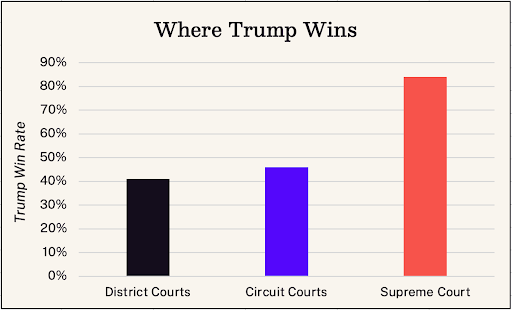
In the district courts, Trump loses—badly. Across 245 district court rulings, his administration lost 59% of the time, a staggering rate for the United States government. That includes losses before judges appointed by Republican presidents, who have ruled against him 54% of the time.
But there’s a striking divide within those Republican appointees. Judges appointed by Republicans other than Trump have ruled against the administration in 79% of cases. Trump’s own appointees? They ruled against him in just 31% of cases.
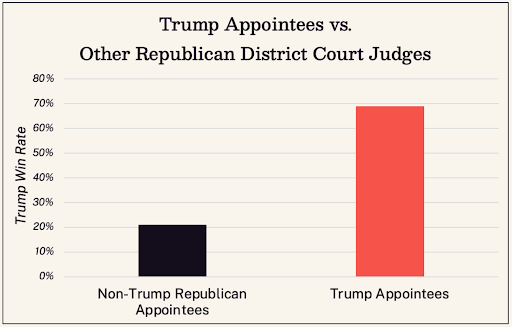
That’s not conservativism. It’s fealty. These aren’t judges applying doctrine in good faith. They are behaving differently from their Republican peers in a way that consistently benefits Trump. The simplest explanation is the correct one: they were selected not for their legal reasoning, but for their loyalty. And they’re delivering.
At the court of appeals level, where confirmation politics have devolved toward brass-knuckles partisanship following Mitch McConnell’s elimination of the circuit court “blue slip”—a procedural tool that once gave senators an effective veto over appointments to circuit court vacancies in their home states—our data reveals a disturbing partisan fracture.
Republican-appointed circuit judges have voted in favor of the administration 87% of the time, while Democratic appointees have voted against it 78% of the time. Again, as reported by The New York Times, Trump’s own appellate judges voted for the administration nearly universally—92% of the time.
But the real story is at the Roberts Court, where, aside from the headline-grabbing tariffs case, the 6-3 Republican supermajority has been Trump’s most reliable judicial ally. Across the 25 rulings we analyzed, the administration won 84% of the time—even including the tariffs case.
Most of these cases came via the shadow docket, where there’s no oral argument, minimal briefing, and often cursory reasoning. These orders are supposed to be—and frequently dismissed as—temporary. In practice, they can cause immediate, irreparable, and widespread harm.
Last fall, for example, when the Court allowed Trump’s directive on race-based immigration detentions to take effect, clearing the way for racially profiled “Kavanaugh Stops,” ProPublica documented what happened next: over 170 U.S. citizens were detained by immigration agents. Some were dragged from their cars. Others were held for days in freezing conditions, in their underwear, denied phone calls to lawyers or family. At least one was tased; another shot.
In another unsigned shadow docket order last year, the Roberts Court greenlit what Senator Elizabeth Warren rightly described as the “greatest theft of personal data in U.S. history,” granting Elon Musk’s DOGE access to all the sensitive data in Americans’ Social Security files. Last month, DOJ acknowledged in court that individuals’ personal data had been disclosed to unauthorized third parties using a non-government server. There’s no putting that cat back in the bag.
It is clear that the U.S. Supreme Court is no longer functioning as a neutral constitutional arbiter or a functional check on President Trump’s dangerous Project 2025 agenda. Instead, it is operating as his enabler-in-chief—and a structural veto on democratic governance.
Of course, the Roberts Court’s pattern of partisan interference is not new. In a series of 5-4 and 6-3 decisions spanning voting rights, reproductive freedom, climate regulation, labor law, gun safety, and more, the Roberts majority has effectively rewritten the Constitution to dismantle the core pillars of 20th-century progress.
Its decisions haven’t merely reversed decades of economic and social compromise and achievement; through rulings enabling unlimited political spending and undermining democratic participation, the Roberts Court has structurally reordered our constitutional system to make future progress impossible.
This latest analysis reinforces that we are hurtling toward a system of “autocratic legalism,” where democracy dies not through military coups but through legal mechanisms that appear legitimate while systematically dismantling popular sovereignty. While litigation can limit the damage, it cannot reverse the tide. Nor can proponents of democracy afford to wait things out. Given the Court’s current 6-3 right-wing supermajority, Republican-appointed justices are projected to control the Supreme Court until around 2065.
So what do we do?
First: Stop pretending the Supreme Court is neutral, or that it will save us.
It’s not, and it won’t. It’s a political institution with immense power, and it’s being used to shield and legitimize a lawless administration. Every shadow docket order should be met with public outrage, not deference.
Second: Stop calling them “conservative.”
Trump’s judges aren’t ruling based on legal doctrine. They’re ruling in lockstep with his agenda, even when other Republicans reject it. That’s not ideology. That’s corruption. Name it.
Third: Tell Congress to fight.
Demand that members of Congress do their job and rein in the Court: enact term limits, enforce an ethics code, strip the Court’s jurisdiction to insulate broadly popular legislation from corrupt judicial invalidation, expand the lower courts to dilute the influence of Trump’s hack appointees. And stop confirming his nominees with bipartisan votes. This isn’t about norms. Norms died when the Court started rubber-stamping abuse of power.
We’re not just in a constitutional crisis. We’re in a corruption crisis. And the Supreme Court isn’t the solution. It’s the heart of the problem. Unless we confront this reality and adjust our strategy accordingly, this will end in a system of competitive authoritarianism legitimized by judicial decree.
It’s time to reclaim our collective power, demand real action from our elected officials, and stop hoping that a small group of unelected politicians in robes will swoop in and save us from autocracy.
Alex Aronson is Court Accountability’s co-founder and executive director. He has served as chief counsel and senior counsel to U.S. Senator Sheldon Whitehouse, managing director of the Institute for Constitutional Advocacy and Protection at Georgetown University Law Center, and an attorney in the Appellate Section of the Civil Rights Division of the U.S. Department of Justice. His commentary has appeared in outlets such as The New York Times, The Washington Post, Politico, The Hill, Rolling Stone, MSNBC, and The Guardian.