Black Women Carried the Wave. The Bill Is Due.
By Deola Adeosun
On Tuesday night, political pundits and TV anchors reached for their favorite words: BLUE WAVE, REBUKE, REALIGNMENT.
Black folks didn’t need a word for it.
According to NBC News exit polls, 93 percent of Black women voted for Democrats for the House. That’s more than any other group in the country, and up from the 92 percent who backed Kamala Harris two years ago. So let me say what too many people will only say for a week: THANK YOU, Black women. Then let me say what nobody wants to hear. Thank you is not enough.
Former Atlanta mayor Keisha Lance Bottoms is the first Black woman ever elected governor of a U.S. state. Juliana Stratton is headed to the Senate, where for the first time three Black women will serve at once. U.S. Virgin Islands leader Stacey Plaskett became the first Black woman elected governor of a U.S. territory. Behind most of those firsts were rooms Black women organized, phone banks Black women staffed, and church vans Black women drove.
To be fair, we weren’t alone this time, and I’m glad. White women, a majority of whom backed President Donald Trump in 2024, voted for Democrats by six points this year, according to NBC News. Black men, Latinas, and even white men moved toward the party too. Welcome, everyone. But look at where each group started. Black women didn’t swing toward anything. We were already there in 2024. We were there in 2020, and in 2018, when Stacey Abrams was knocking on doors across South Georgia. We made up just 5 percent of this electorate and still gave Democrats a larger share of our vote than any other group. Every wave lands on the same shore. We are that shore.
I am a Nigerian woman who has proudly called Georgia home for more than 30 years, and my debt to Black America started before I ever got here. In the early 1980s, my mother came to this country on her path to becoming a nurse. She had the grades, and she had the money, but apparently not the right skin color. Two decades after the Civil Rights Act, school after school still turned her away. Fisk University, the Historically Black College in Nashville, was the only one that would take her. When other institutions closed their doors to an African woman, a Black institution opened one.
Every immigrant who has come to this country since the 1960s, including me, walked through doors that Black Americans broke open. The Civil Rights Act of 1964 outlawed discrimination based on race, color, religion, sex and national origin in hiring, in public places and in any program that received federal money, including colleges. A year later, carried by the same movement, Congress passed the Immigration and Nationality Act of 1965. It ended four decades of national-origin quotas that favored Northern and Western Europe and all but shut out Africa and Asia. None of it was given freely. Medgar Evers was assassinated in his own driveway in 1963. Four little girls were killed in a Birmingham church bombing that September. James Chaney, Andrew Goodman and Michael Schwerner were murdered in Mississippi less than two weeks before the Civil Rights Act was signed. Every immigrant class since has benefited from that sacrifice, mine included.
I have watched Georgia go from deep red to purple to blue, and none of it was luck. Stacey Abrams lost the governor’s race twice. Between those losses, she built the registration drives, organizing networks and coalitions that flipped Georgia for Joe Biden in 2020 and sent Raphael Warnock and Jon Ossoff to the Senate. She never got the keys to the governor’s mansion. She paved the road anyway, and on Tuesday another Black woman walked it.
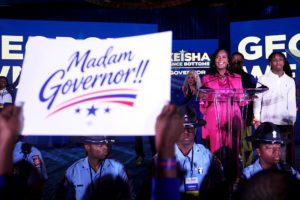
Bottoms traces her family back five generations to Sheppard Peek, a man listed in 1860 among an enslaver’s possessions near Crawfordville, Georgia. On the eve of the election, she visited her ancestors’ graves. In five generations, her family went from being counted as property to holding the state’s highest office. That is not a fairy tale or feel-good story. It is a ledger, and Black women have been paying into it for a very long time.
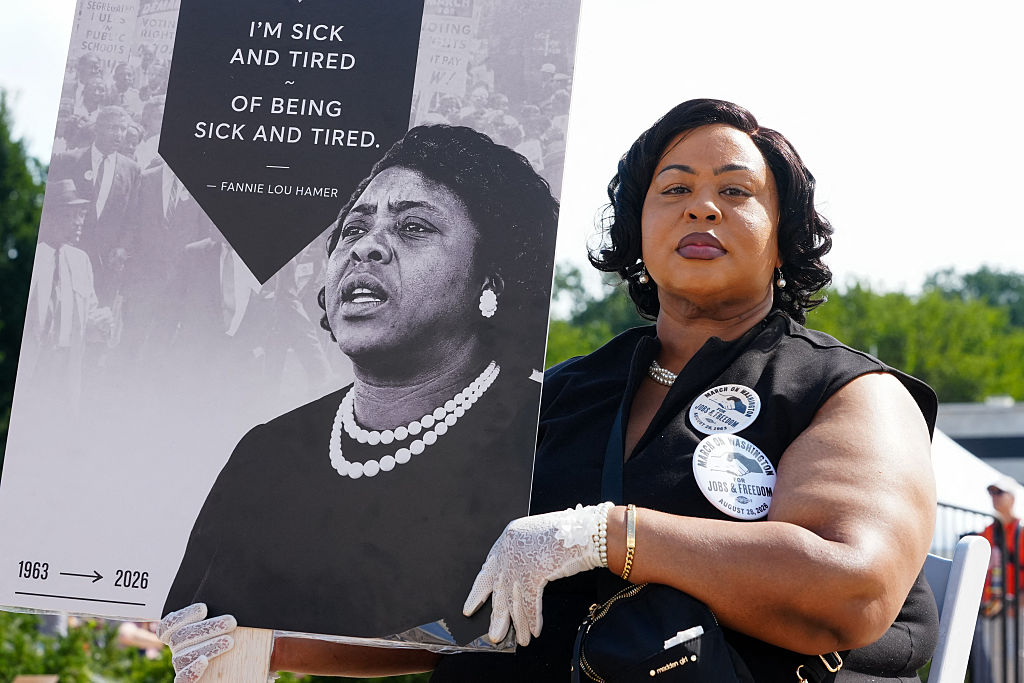
Fannie Lou Hamer was beaten in a Mississippi jail for helping Black people register to vote. In 1964, she went to the Democratic National Convention, told the country what that work had cost her, and refused the party’s offer of two token seats. Shirley Chisholm ran for president in 1972, “unbought and unbossed,” while much of her own party looked away. More than a century earlier, Sojourner Truth demanded that a movement for women recognize Black women as women. Every time, the country took what these women gave and moved on without paying.
Here is the part the victory parties leave out. Black women are the Democratic Party’s most loyal voters, by a margin no other group approaches, and among its least protected constituents.
In 2025, Black women’s employment rate fell 1.4 points to 55.7 percent, one of the sharpest one-year drops in a quarter century, according to the Economic Policy Institute (EPI). Our unemployment rate climbed to 6.7 percent. College-educated Black women were hit hardest, and EPI found the net loss came entirely from the public sector, mostly federal jobs. For generations, government work was a path into the middle class for Black women. Last year, it became the door pushing us out. The Institute for Women’s Policy Research (IWPR) estimates that more than 250,000 Black women lost jobs between January and August 2025 alone.
So the women who saved the country this week are the same women it spent two years pushing out of work. When Black women stepped back after 2024 to grieve, rest, and regroup, we were scolded for it. We were called selfish and told the stakes were too high for us to sit down. Then we showed up anyway, the way we always do.
They say you bring a Black woman into a failing company when it needs critical repair. I guess they’re right. But you don’t get to call us in for every emergency and ignore us the rest of the time.
So here is the invoice:
Bring back the jobs, and count who lost them. The new Congress will have subpoena power and control of the budget. It should use both to investigate the federal layoffs that hit Black women hardest, push for reinstatement where possible, and require agencies to report workforce cuts by race and gender. What isn’t counted can’t be fixed.
Restore the accountability data. IWPR researchers warn that rolling back equity protections and the employer reporting that holds companies accountable hurts Black women first and then every other worker. Restoring pay-data reporting and funding enforcement costs very little, and it is long overdue.
Protect the vote we keep using to save you. Pass the John Lewis Voting Rights Advancement Act in the first session, not the fourth. Black women have been told to outrun voter suppression every cycle. That is not a strategy.
Make care policy real policy. Child care, paid leave, and maternal health are not niche issues. Black women still die from pregnancy-related causes at roughly three times the rate of white women. Pass the Black Maternal Health Momnibus. Here in Georgia, Governor-elect Bottoms campaigned on expanding Medicaid. We will hold her to that promise as firmly as we hold everyone else to theirs, because loyalty to a person is not the same as loyalty to a promise.
Give us power, not photo ops. That means committee gavels, chief-of-staff jobs, consulting contracts and campaign budgets. It means seats in the rooms where strategy is decided, not just a spot in the ad that runs the week before Election Day.
Name it when it happens, including inside your own party. Misogynoir doesn’t only come from the other side. It shows up when a Black woman loses, and the lesson is “electability,” while a white man who loses gets another run. It shows up when our turnout is called “the base,” and our concerns are called “a distraction.” Leaders who benefit from our votes should call it out in public, not just in the group chat.
Your party is not safer for Black women just because we carry it on our backs. Carrying is a choice. At some point, we can set you down and let you find out what the road feels like without us.
Hamer said she was sick and tired of being sick and tired. Sixty-two years later, we are still tired. We are also ready.
So thank you, Black women. And to everyone else celebrating this blue wave: we did our part. Now do yours, so we can finally rest.