LaMonica McIver’s case for turning Black women’s resilience into power
By Michael Jones
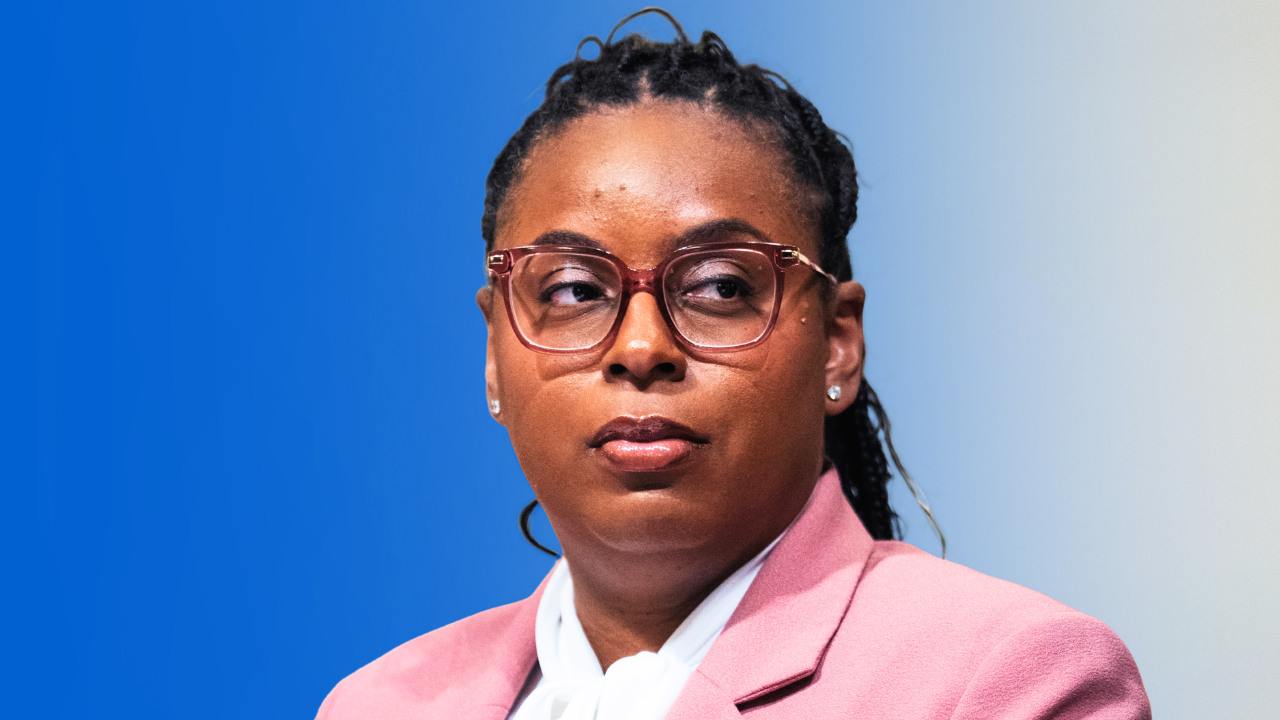
Rep. LaMonica McIver has had plenty to celebrate at this year’s Congressional Black Caucus Foundation Annual Legislative Conference.
The New Jersey Democrat is expecting her second child any day now. And this week, Rep. Bonnie Watson Coleman (D-N.J.), a mentor to McIver who will retire at the end of her term, helped pass another responsibility to the next generation: McIver will become a co-chair of the Congressional Caucus on Black Women and Girls next Congress.
But when McIver gathered Black women executives and business leaders this week to discuss their influence on American business and culture, she wasn’t interested only in celebrating how far Black women have come.
She wanted to talk about what it has taken to get there.
“When you don’t give us a seat at the table, we will build a new table with chairs and a boardroom,” McIver told the crowd.
It was a celebration of resilience that also raised an uncomfortable question: Why should Black women always have to build another table?
The answer matters beyond the conference rooms of the Congressional Black Caucus’s marquee annual gathering. Black entrepreneurs still face significant disparities when they seek the money they need to build and expand their businesses.
Just 35% of Black-owned small businesses that applied for loans, lines of credit or cash advances were fully approved for the financing they sought, compared with 56% of white-owned firms, according to the Federal Reserve Banks’ 2024 Small Business Credit Survey. The figures aren’t adjusted for differences such as profitability or credit risk. Still, the disparity is consistent with years of findings showing that Black business owners face greater difficulty obtaining financing.
That gap exists against an enormous racial wealth divide. The Federal Reserve’s most recent Survey of Consumer Finances found the typical Black family held $44,900 in wealth in 2022, compared with $285,000 for the typical white family. While Black families experienced substantial wealth growth between 2019 and 2022, the typical white family still held more than six times as much.
McIver, who serves on the House Small Business Committee, said she sees the consequences firsthand.
“When you talk about a Black business specifically, I think the access to capital is a big problem,” she told reporters after the panel.
Black businesses, she said, often cannot obtain the same access to capital as white-owned businesses, making it harder both to get started and to survive once their doors open.
“The playing ground is not fair from the start,” she said.
The women McIver invited to join her put flesh on those statistics.
Talisha Bekavac, executive vice president of the U.S. Black Chambers, described persistent difficulties securing capital and contracts even as Black women have become a rapidly growing group of entrepreneurs. She also described a less visible form of exclusion: women being brought onto contracting teams when their participation helps secure a contract, only to be sidelined once the deal is won.
“A lot of times, it’s just men subcontracting the men,” Bekavac said. Women, she added, can be brought onto teams and then “starve[d]” of work or paid late.
Rhonda Adams-Medina, Audible’s global head of business affairs, described another burden successful Black professionals can inherit once they make it through the door.
As a Black person in a position of influence, she said, “you’ve got a second job”: making sure you aren’t the only one who gets through it.
Adams-Medina said she has deliberately expanded hiring searches when human-resources departments failed to present diverse candidates and has resisted relying on elite-school credentials as a shortcut for talent. Despite attending Princeton and Harvard Law School herself, she said she has never hired anyone from either institution.
“I look for the person who can do the job,” she said. “I don’t look for labels.”
There is something admirable about that sense of responsibility, but also something revealing about its necessity.
Again and again, Black women who reach positions of power are celebrated not merely for doing the jobs they were hired to perform, but for taking on the additional work of opening doors, mentoring the people behind them and repairing institutional shortcomings they did not create.
McIver doesn’t think that responsibility belongs to them alone.
I asked her what her colleagues who aren’t Black women—particularly those with committee gavels, leadership positions and other forms of institutional power—should take away from the discussion.
“Sometimes our counterparts, especially when they don’t look like us, they think that it’s not their problem what’s happening to Black people,” McIver said without hesitation. “It’s your job to speak up.”
She compared remaining silent about racial discrimination to watching something racist happen to a Black friend and doing nothing. McIver extended the argument to people experiencing inequities in corporate America and to political fights over immigration and diversity, equity and inclusion policies.
“If not, you’re just complicit to the problem,” she said.
That challenge comes as the federal government’s approach to race-conscious economic programs is changing.
The Small Business Administration proposed a rule in June that would eliminate the use of presumed social disadvantage based on membership in certain racial groups in its 8(a) Business Development Program, which helps eligible small businesses compete for federal contracts. The Trump administration describes the change as eliminating racial discrimination. (Applicants would instead have to demonstrate social disadvantage through individual evidence.)
The policy fight can become abstract quickly. The experiences McIver elevated this week make its stakes considerably more concrete.
Kathryn Busby, president of original programming at Starz, described representation as both an opportunity and good business. She said the company remains committed to stories by and about women and underrepresented communities regardless of whether doing so is “in vogue or out of vogue.”
Authentically telling stories about communities that have historically been overlooked isn’t merely “the right thing to do,” Busby said. “It’s actually the profitable thing to do.”
The success of Black women can demonstrate what happens when barriers are overcome, but it shouldn’t be mistaken for evidence that those barriers have disappeared.
Resilience is an admirable quality in an entrepreneur, an executive or a member of Congress. But it’s not a replacement for meaningful economic policy. And celebrating people for repeatedly overcoming an uneven playing field is no substitute for leveling it.
Black women have shown they can build their own tables.
McIver’s challenge to everyone else is to ask why they so often still have to.
Michael Jones is an independent Capitol Hill correspondent and contributor for COURIER. He is the author of Once Upon a Hill, a newsletter about Congressional politics.