New Mexico’s ‘Epstein loophole’ is still on the books. It’s not the only one.
By Jackie Appel, Investigative Reporter
A legislative committee tasked with investigating Jeffrey Epstein’s crimes in the state are working to close a loophole in New Mexico’s sex registry laws that allowed the sex trafficker to operate in the state virtually undetected.
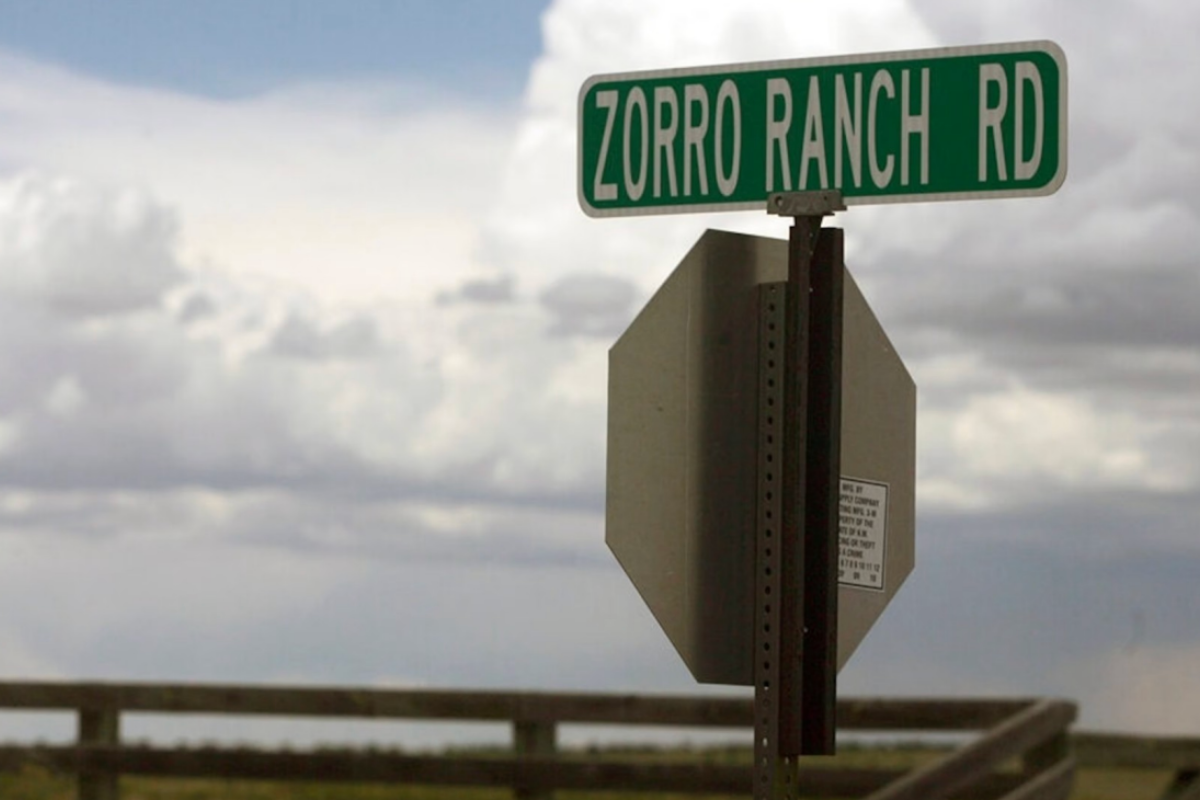
The New Mexico Survivors’ Truth Commission — a bipartisan delegation of state representatives dedicated to investigating Epstein’s operations in New Mexico — recently published specific details regarding how Epstein was able to use a loophole to avoid registering as a sex offender in the state of New Mexico. This let him to fly largely under the radar for decades as he assaulted at least 30 victims on his Zorro Ranch property.
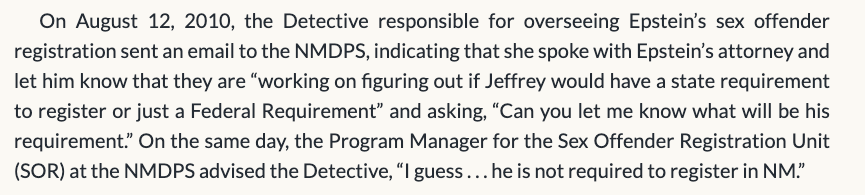
The commission obtained documents from a number of state and federal agencies, which included internal correspondence between law enforcement officials who deliberated over how to handle Epstein’s registration status:
What the Epstein Files reveal
Further inspection of documents released as part of the Epstein Files Transparency Act reveal exactly how Epstein navigated the legal requirements to skirt registration. One of Epstein’s lawyers, Peter Schoenburg, wrote: “I do not read [the offense to which Epstein plead guilty] as falling within one of the enumerated SORNA qualifying offenses under NMSA 1978, § 29-11A-3(E) (defining ‘sex offense’ for purposes of the New Mexico SORNA provisions).”
Essentially, Schoenburg argued that Epstein’s Florida conviction did not qualify as a “sex offense” according to New Mexico’s legal definition. The claim hinges on the fact that Epstein pleaded guilty to “procuring [a] person under [the] age of 18 for prostitution” in Florida—a crime which involved a 17-year-old victim (though her actual age is disputed). This conviction meant he had to register as a sex offender in Florida and in New York, where he also maintained residences.
However, the text of New Mexico’s closest similar statute, “sexual exploitation of children by prostitution,” stipulated that to be convicted of a crime, the victim must be “a child under the age of sixteen.” According to the state’s definition, a “sex offense” encompasses any number of crimes — including “sexual exploitation of children by prostitution” — and “their equivalents in any other jurisdiction.” Schoenburg argued that Florida’s “procuring [a] person under [the] age of 18 for prostitution” statute and New Mexico’s “sexual exploitation of children by prostitution” statute are not equivalent, and therefore, Epstein had not committed a sex offense according to New Mexico law.
The argument appeared to be legally sound, and was accepted by the New Mexico Department Of Public Safety.
“It’s shocking and upsetting that 16 and 17-year-olds do not currently have the same protections as younger children under state law,” State Rep. Andrea Romero (D-Santa Fe), chair of the New Mexico Survivors’ Truth Commission, told COURIER in an email. “We are prepared to right that wrong in the coming legislative session.”
Closing the loophole
Renewed interest in Epstein’s loophole has prompted lawmakers to finally close it in the upcoming legislative session. The Survivors’ Truth Commission is expected to propose a solution as part of its final report, and State Rep. Meredith Dixon (D-Albuquerque) recently announced she would file a package of legislation to close the loophole, “spearheaded” by Attorney General Raúl Torrez, who is running a separate criminal investigation into Epstein.
In the past, according to Dixon, several efforts have been put forth to bring New Mexico’s relevant statutes up to date, but they’ve never made it to the House floor. Now, however, with the spotlight on the Epstein case, she is hopeful that the time has finally come for legislators to accept that change is necessary.
“What has happened, I think, is that now—with […] the Epstein Commission looking at Zorro Ranch and this loophole—I think there’s a better understanding by legislators and members of the public of exactly why we need to make some of the changes that we’ve been asking for,” Dixon said. “I think previously, it may not have been clear. There may not have been an example that made everyone realize, aha! This is why we need to change [the statutes].”
If passed, the change in state laws would serve as a stepping stone towards tightening the messy legal web of laws that aim to protect victims of sexual crimes, but often allow affected individuals to fall through the cracks and perpetrators to avoid accountability.
“I think it’s more accurate to think, in the context of US trafficking, that the whole system is a loophole,” Andy Forest, a research fellow at the nonprofit Coalition to Abolish Slavery and Trafficking (CAST LA), told COURIER. “We made the country on the basis of trafficking people [slavery]. So, it’s not so much that we made this tight system and we have to close loopholes now. We have to make the system no longer a whole mess of loopholes.”
More gaps as new technology emerges
Forest highlighted an August decision—arrived at by a three-judge panel of the US Court of Appeals for the 7th Circuit—that AI-generated child sexual abuse material (CSAM) as another area where legislation makes it harder for victims of sexual crimes to get the justice they deserve. While not a loophole like the New Mexico statute, Forest says that the decision closes the door to legal recourse for many survivors of abuse perpetrated largely online.
“Let’s say I am a survivor of child sex trafficking,” Forest said. “Images have to feed [the AI image generator]. I never get to know if mine were the ones that would feed it. So the problem that this is creating for survivors is that it allows more sexual abuse material to be created of individuals, and there’s absolutely no recourse.”
For example: under this court decision, the generation and retention of CSAM for personal use is legally protected, as long as the images generated are of “fake” children — even though the AI image generator was trained to make those images using actual children. As long as the person generating the images didn’t use actual children to create the model, they would not be considered a sex offender. Similarly, under the Epstein loophole someone who solicits a 16- or 17-year-old child for prostitution is not considered a sex offender.
Emerging gaps in the US legal system like this one, and longstanding issues like the Epstein loophole, provide legal avenues for perpetrators to take advantage of victims without breaking any laws.
Laws are specific by necessity, but that specificity can leave victims out in the cold. While future changes won’t help past victims, small adjustments to a phrase or definition can make a world of difference for any potential future victims. Advocates like Forest are hopeful that the adjustments necessary to close the New Mexico loophole will come as a result of Dixon and Torrez’s proposed legislative package, or from suggestions put forth by the Survivors’ Truth Commission.
In the meantime, the Survivors’ Truth Commission will continue their investigation into the goings on of Zorro Ranch and the bureaucratic failures that allowed them to take place for so long. The commission is expected to release their final report this December.

COURIER’s newly-launched Epstein investigation project
For too long, the Epstein Class has dealt in wealth, power, and politics to avoid accountability and deny victims & survivors their due justice. The public deserves the truth, but the Trump Administration is failing its legal obligation to deliver it.
That’s why we’re expanding our coverage to follow the money and investigate the power players in and outside the government. With a new database by Thorian AI, we have unprecedented access and ability to navigate more than 1.2M files and we’re sharing access—and what we’re finding—with you.
Subscribe to The Cover-Up and get one concise, easy-to-read email a week that cuts through the noise with the headlines you need and the breakdowns you want.
By staying plugged in and leveraging our reporting to make your own calls-to-action louder, together, we can turn information into justice.