What’s At Stake: One Cancer Survivor, One Lawmaker, One System Under Fire

By Clara Rhodes
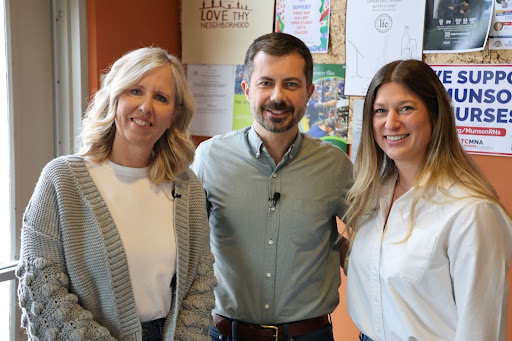
In early March, Protect Our Care travelled to the small town of Traverse City, Michigan to speak with former Transportation Secretary Pete Buttigieg about the stakes of the ongoing health care crisis.
That day, we were joined by Victoria Sylvester: fellow Michigander, small business owner, cancer survivor, and Affordable Care Act (ACA) enrollee whose life has been acutely shaped by the very policies now under attack by Republicans in Congress.
This is her story.
Victoria was born and raised in Traverse City, where she later returned to build her life with her husband. She operates her own small business, working as a freelance hair stylist with a studio in town, while her husband works in the trades as a custom woodworker.
Prior to the enactment of the ACA in 2010, neither Victoria nor her husband had health insurance. It was simply an unaffordable expense, and a risk they were forced to take. In our conversation, Victoria described it as “a little Russian-roulette feeling…going through life without insurance.” They were careful, of course, but careful only gets you so far.
Like millions of Americans, Victoria never expected that access to health care would become one of the defining challenges of her lifetime.
So when the ACA opened the health insurance marketplace and affordable coverage was — for the first time — within reach, their relief was immediate. It meant they could access medical care when they were sick or injured, without the worry of high costs or debt; it meant her husband took on less risk while at work; and, it meant that 12 years later, when Victoria felt a lump in her abdomen, she could actually get the care she needed.
It was 2022 when Victoria first felt the small, hard mass in her lower belly. After consulting a doctor, she underwent a surgical biopsy and, on June 13th, 2022, she was diagnosed with Stage III Clear Cell Carcinoma ovarian cancer. What followed was a grueling routine: major surgery, months of aggressive chemotherapy, and years of ongoing monitoring.
Today, she is just past the two-year mark, under monitor but cancer-free.
Through it all, her ACA coverage ensured that Victoria had reliable access to the care that was quite literally saving her life. The ACA was a rare boon in an otherwise unforgiving and unaffordable system — one where a single diagnosis could upend not only one’s health, but also their financial stability.
“After I met my deductible, it was amazing,” she said. “It took away the worry of, ‘Can I have this treatment?”
But stability was never guaranteed. When Congressional Republicans began their campaign to gut the American health care system — in which they cut over $1 trillion from Medicaid and decimated the ACA — they carelessly threatened a very real lifeline for millions of Americans.
With her access to health care under threat, Victoria found herself panicking. She recalled “Sitting up at night with a notebook, trying to figure out how we’d afford it. Could I work more? What could we cut? Do we need to make extreme decisions just to protect ourselves?” But ‘working more’ is not a true option when your body has undergone such a trauma.
For a cancer survivor still in active monitoring — or what doctors call “no evidence of disease,” but not full remission — coverage is absolutely, undeniably essential. Though Victoria’s cancer responded miraculously well to treatment, she still requires regular medical attention, including visits with cardiology and vascular specialists, port flushes, and routine scans and monitoring.
As such, the expense of her ongoing care is enormous. Even with the ACA, Victoria’s deductible is $7,500 per year — a high but ultimately manageable cost, considering the alternative. Notably, that annual cost excludes all those other related expenses that Victoria must manage alongside her care. Her medications have their own out-of-pocket costs, she must cover transportation to and from visits to specialists, and when she visits the cancer treatment center for regular monitoring, a port flush – the site where her chemotherapy treatment is delivered – costs $200 each time.
Without the help of the ACA, Victoria may have had to forgo or delay her care altogether — a decision that could have quickly turned a treatable diagnosis into something far worse.
Today, and as a result of a concerted effort by the Republican Party, the coverage that Victoria relies upon through the ACA is being methodically chipped away.
In Washington, D.C., Congressional Republicans — backed by President Donald Trump — have pushed a series of policies that cut health care funding, undermined the ACA, threatened hundreds of hospitals and care facilities, and put millions of Americans at risk of losing coverage.
When Republican lawmakers vote to cut coverage or let the tax credits expire, they are not just moving numbers around in a budget — they are raising costs, increasing risks, and placing lives in jeopardy. Victoria’s story is a clear example of that fact: health care access is often quite literally the difference between life and death.
“I refuse to let my health care decisions for my body be dictated by whether or not I can afford it,” she said. “Nobody’s going to tell me if I can live or die because of money. … I will fight that to the bitter end.”
Victoria chose to speak out because she knows she is not alone. “For one of me, there’s millions,” she says.
To hear more of her story — and to see her conversation with Secretary Buttigieg about what’s truly at stake in this fight — watch the full interview from Protect Our Care.