Why Jeffries took the redistricting fight to Annapolis
By Michael Jones
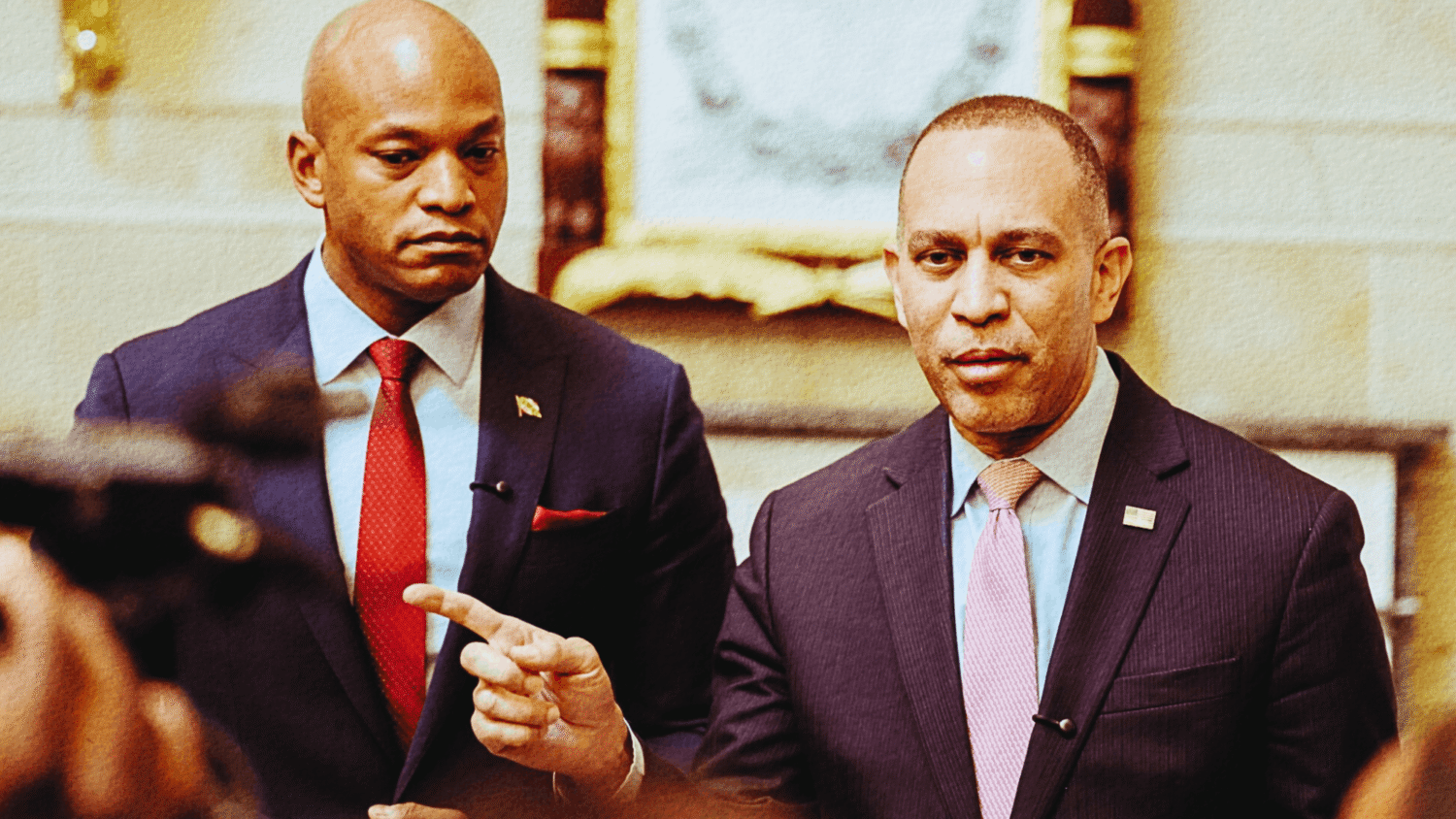
Maryland Democratic Gov. Wes Moore, state House Speaker Joseline Peña-Melnyk, Legislative Black Caucus Chair Scott Phillips and the Maryland House Democratic Caucus got a visit from House Minority Leader Hakeem Jeffries (D-N.Y.) last week after the state House recently advanced a revised congressional map that would eliminate the state’s lone Republican district ahead of November’s midterms.
But Jeffries didn’t make the trip to Annapolis just for a thank-you tour. He also sat down with Maryland Senate President Bill Ferguson—the one Democrat standing between Jeffries and the 8–0 delegation he’s been chasing as a counterweight to Republican mid-decade gerrymanders elsewhere in the country.
Ferguson, who has opposed redrawing the map since last September, said he welcomed the conversation but wasn’t moved.
“It’s precisely because we want Leader Jeffries in the majority that most members in the Maryland Senate Democratic Caucus do not support moving forward with mid-cycle redistricting that will backfire in our state courts and lose Democrats in Congress,” Ferguson said.
Jeffries struck a more measured tone.
“Bill Ferguson authentically believes that the votes don’t exist in the State Senate to move forward. The only way to find out is to allow an immediate up-or-down vote on the Senate floor with respect to the new congressional map passed by the House of Delegates,” Jeffries said in a statement after the meeting. “With our country under extreme assault by Republicans, the people of Maryland deserve nothing less.”
Back on Capitol Hill hours later, Jeffries was asked whether Ferguson committed to holding that vote. “It’s my understanding that he’s going to have a conversation with his members and we’ll see what happens from there,” he said.
The standoff captures how national—and personal—the redistricting fight has become ahead of the November election. With Republicans controlling Washington and aggressively pursuing mid-decade remaps to protect their slim House majority, Jeffries has made clear that Democrats won’t sit on the sidelines. He’s spending political capital to press blue states to respond in kind. And the stakes aren’t abstract: reclaiming the majority is the only path to the speaker’s gavel that would provide the check on the Trump administration that he says Republicans have been too obsequious to apply themselves.
Jeffries often tells reporters he’s simply finishing a fight Republicans started last summer, when President Donald Trump publicly urged Texas Republicans to redraw the state’s congressional map to net five additional GOP seats—an extraordinary request given that redistricting traditionally follows the census once a decade.
Texas House Democrats fled the state to deny quorum, echoing their 2021 walkout. Republicans responded with multiple special sessions and ultimately muscled the map through before Gov. Greg Abbott signed it. Civil rights groups and Democrats immediately sued, arguing the new lines diluted minority voting strength in violation of Section 2 of the Voting Rights Act. A federal court initially blocked the map, but the Supreme Court is allowing it to be used in 2026 while litigation proceeds. The new lines expand Republicans’ advantage from 25 to 30 of Texas’s 38 seats.
Democrats quickly looked for a counterpunch in the only state larger than Texas: California. Gov. Gavin Newsom embraced the fight. Lawmakers placed—and voters approved—Proposition 50, a temporary constitutional amendment suspending the state’s independent commission map and replacing it with a Democratic-drawn plan targeting five Republican-held districts. The redesign makes those seats substantially bluer, effectively offsetting the five-seat GOP gain Texas sought. It also shores up Democratic margins in several competitive districts, narrowing future Republican opportunities.
After Texas and California largely canceled each other out, Trump’s team encouraged Missouri Republicans to find another seat. Gov. Mike Kehoe called a late-summer special session to redraw the map before 2026. The centerpiece was Missouri’s 5th District, anchored in Kansas City and represented by Emanuel Cleaver since 2005. The proposal split Democratic-heavy areas and stretched the district into more rural territory to tilt it Republican. The map passed and was signed into law, though opponents gathered enough signatures to put a repeal on the 2026 ballot, leaving its ultimate fate uncertain.
Jeffries argues that Republicans were only able to maintain their narrow House majority in 2024 because of North Carolina, where the Republican-controlled General Assembly enacted a map that shifted the delegation from an even 7–7 split to a 10–4 GOP advantage. Last fall, state Republicans went further, advancing another mid-cycle redraw aimed at flipping the lone competitive seat in the 1st District, held by Don Davis. Because North Carolina’s governor has no veto power over redistricting, the legislature acted unilaterally.
Trump next turned to Indiana, lobbying state Republicans to eliminate the state’s two Democratic seats and produce a 9–0 GOP delegation. As in Maryland, the state House advanced the proposal, but it stalled in the Senate. Trump publicly threatened to back primary challengers against Republican senators who resisted and made direct appeals to lawmakers. The effort collapsed anyway. In December, the Indiana Senate—despite its GOP supermajority—rejected the bill 31–19, with 21 Republicans joining Democrats to defeat it, killing the mid-decade redraw.
By then, Democrats were already pressing forward in Virginia. With the delegation currently split 6–5 in Democrats’ favor, party leaders there are attempting a high-risk bid to push it toward a potential 10–1 edge. Because Virginia’s constitution vests redistricting authority in an independent commission, Democrats passed a constitutional amendment to return that power to lawmakers for a mid-decade redraw temporarily. The amendment must be approved in a statewide referendum slated for late April. The process has faced court challenges, including a lower court ruling that briefly blocked the vote before the Virginia Supreme Court cleared the way for it to proceed. Gov. Abigail Spanberger has signed legislation approving a new map contingent on voter approval. Jeffries has pledged to invest heavily to ensure that outcome.
Florida is the next potential front. The state House created a Select Committee on Congressional Redistricting in December to explore a mid-decade redraw, though no draft maps have been released. Gov. Ron DeSantis has called a special session in April to take up the issue. But internal GOP disagreements over strategy and timing, along with the state’s Fair Districts constitutional amendments and the threat of litigation, complicate the path forward. Whether Florida joins the mid-decade escalation—and how aggressive any plan might be—will likely be decided in the coming weeks.
What’s most striking about the redistricting wars is how dramatically the political terrain has shifted since Trump set them in motion.
When he first urged Texas Republicans to squeeze five additional GOP seats out of their map, the assumption in Washington was that Republicans would bank most—if not all—of them. But the political climate has cooled for the party. Off-year and special election results over the past year, combined with historical midterm trends, suggest Democrats could blunt Texas’s gains, with some analysts projecting Republicans may net closer to three seats than five.
Elsewhere, the ground is moving, too. The Utah Supreme Court recently affirmed a remedial congressional map that makes one district genuinely competitive in a state where Republicans currently hold all four seats. Democrats now have a plausible pickup opportunity where none existed before.
Layer on top of that Trump’s sliding approval ratings and mounting voter frustration over congressional Republicans’ failure to deliver on affordability—the kitchen-table issue that cut through in 2024—and the map math suddenly looks less deterministic. Lines still matter. But so does the environment. And the environment has shifted quickly.
That’s the quiet irony of this entire saga: Republicans launched an aggressive, nationalized redistricting campaign, assuming favorable political winds. Just months later, those winds appear far less certain—and in some places, may even be blowing the other direction.
“Donald Trump and Republicans thought they were going to steamroll us, but they’ve learned otherwise,” Jeffries told reporters last month after meeting with Gov. Moore in the U.S. Capitol. “Because we’re standing up for the people that we represent, for the values here in America, and we’re not going to let our foot off the gas.”
Michael Jones is an independent Capitol Hill correspondent and contributor for COURIER. He is the author of Once Upon a Hill, a newsletter about Congressional politics.