Why the backlash to Laura Loomer’s attacks on Black women matters
By Michael Jones
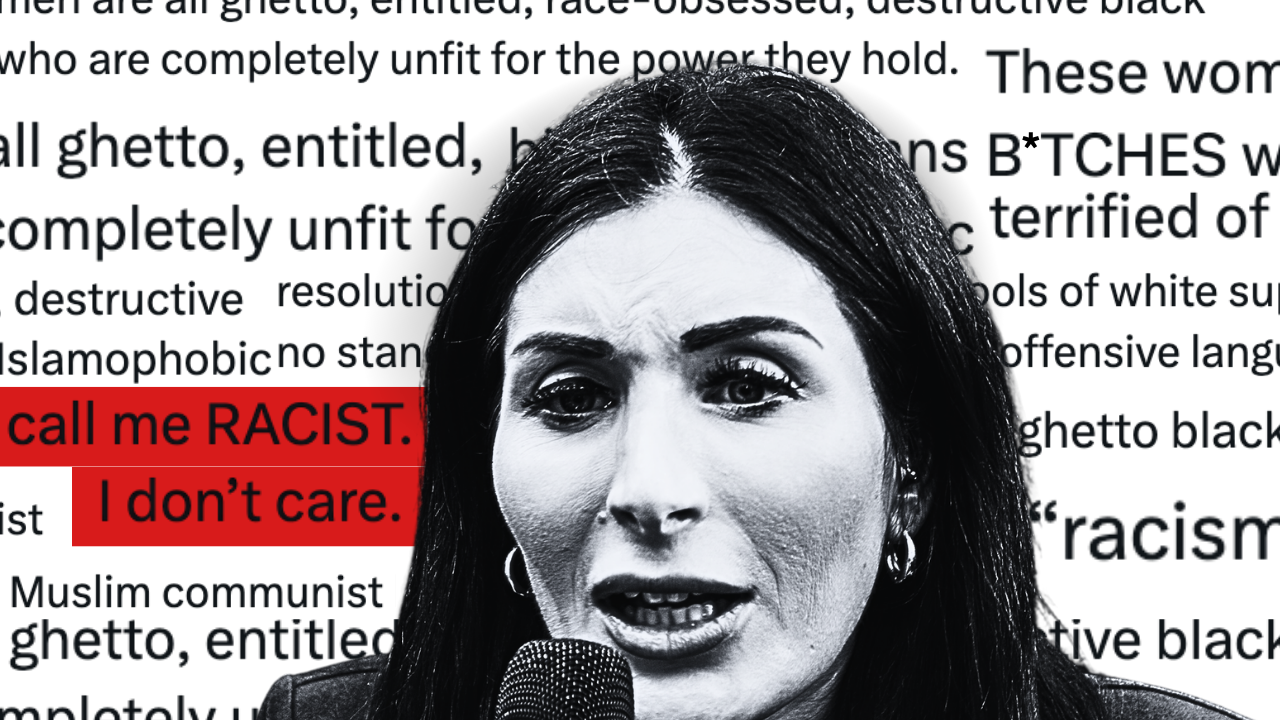
When Laura Loomer went after Florida state Rep. Angie Nixon last month, she wasn’t exactly subtle.
The right-wing activist and close ally of President Donald Trump unleashed a series of racist attacks against Nixon and several other prominent Black women in public life, including Supreme Court Justice Ketanji Brown Jackson, Reps. Ayanna Pressley (D-Mass.) and Ilhan Omar (D-Minn.) and former Rep. Cori Bush (D-Mo.).
The attacks on Nixon, a Democratic candidate for U.S. Senate, drew a particularly forceful response. Politicians and public figures rallied to her defense. Members of Congress denounced Loomer. The Congressional Black Caucus weighed in.
The backlash was striking in its breadth.
But Rep. Summer Lee (D-Pa.) told me there’s another question worth asking: Why should it take an especially grotesque episode of racism for Black women to receive that kind of solidarity in the first place?
Lee, the first Black woman elected to Congress from Pennsylvania, has dealt with racist abuse since long before she acquired the national profile that comes with serving in Congress. She said prominence can actually give people, in their minds, permission to say things about Black women they might otherwise suppress.
“People use that higher profile as an excuse,” Lee told me. “All their racist fantasies—they’re like, well, I can use them on these public figures and get away with it.”
The problem is bigger than Loomer.
“Anti-Blackness has been pervasive throughout this entire administration, and obviously not just this administration, but definitely this one,” Lee said. “And it just doesn’t get the attention that other forms of hate or bigotry get, because people expect that anti-Blackness is just the norm.”
Then she put her finger on an assumption that has followed Black women through American public life for generations: They can take it.
“Black women know how to handle it, right?” Lee said. “Like, I don’t have to worry. I don’t have to check in on that Black woman because they’re strong. And that’s how they treat all of us.”
That expectation—the strong Black woman who can endure whatever gets thrown at her—is often framed as admiration. In practice, it can become an excuse for indifference.
And American politics has spent generations demanding that Black women endure.
Long before social media made it possible to hurl a racist insult at an elected official from a smartphone, racial stereotypes were used to define which Black women were considered respectable, intelligent, feminine or worthy of exercising authority. Black women who challenged existing power structures could be cast as angry, aggressive, ignorant or otherwise outside the boundaries of acceptable public life.
The particulars have changed across generations, but the underlying function is familiar: reduce a Black woman to a racial caricature and you make it easier to dismiss her ideas, question her competence and portray her presence in positions of power as illegitimate.
That history matters because Loomer isn’t shouting into some political vacuum.
She has maintained proximity to a president who has himself repeatedly attacked prominent Black women. And House Minority Leader Hakeem Jeffries (D-N.Y.) told me he sees Loomer’s rhetoric as part of something broader.
“We’ve seen an unprecedented attack on Black women by the Trump administration and MAGA extremists,” Jeffries said, pointing to attacks against New York Attorney General Letitia James, Rep. LaMonica McIver (D-N.J.) and Federal Reserve Governor Lisa Cook.
“Laura Loomer’s extreme racist comments are just an extension of the assault that we’ve seen on Black women all across America by the Trump administration,” he added. “It’s unacceptable, unpatriotic and un-American. We’ve got to forcefully push back against it.”
Jeffries was even more direct during a recent press conference, calling Loomer a “stone-cold racist” and saying Republicans in Congress and the White House should be ashamed to continue associating with her.
Rep. Christian Menefee (D-Texas), who publicly defended Nixon despite telling me the two have never met, made a related point.
“We’ve seen the president declare war on Black women,” Menefee said, citing Trump’s rhetoric toward Jackson and former Vice President Kamala Harris, along with attacks on Omar and Pressley.
But Menefee’s criticism wasn’t reserved for Republicans.
“What I’ve seen from folks in media and folks on the Democratic side is a silence and a failure to stand up and stand in the gap for Black women,” he said.
Menefee noted that Black women are among the Democratic Party’s most important constituencies, but he rejected the idea that their political importance should be the reason others defend them.
“Even if they weren’t, they are human beings who deserve dignity and respect and protection,” he said.
Political solidarity can easily become transactional: Defend the people whose votes you need. Praise the constituency that anchors your coalition. Condemn racism when the offense becomes so egregious that silence carries its own political cost.
But Lee is asking for something harder.
She told me she notices how quickly people mobilize when other groups or public figures are attacked. She sees the Facebook posts, tweets and Instagram messages. But when racist abuse fills her comment section or those of other Black women, the response can feel different.
“It’s almost like they just move on, they go about their life, and everyone’s like, ‘Oh, that was gross,’ but they don’t actually give it the same energy that they give other people,” Lee said. “That is a normalization.”
And normalization is precisely why this episode matters beyond whatever Loomer posts next.
The backlash to her attacks on Nixon demonstrated that elected officials and institutions can respond forcefully when a Black woman becomes the target of overt racism. But solidarity is most meaningful when it isn’t reserved for the moments that are easiest to condemn.
It requires challenging the subtler assumptions that make the spectacular episodes possible: that Black women are uniquely equipped to withstand abuse, that racist attacks are simply part of the price of seeking power, that someone else will speak up or that saying something could make a family gathering, friendship, workplace or political coalition uncomfortable.
Lee told me that discomfort is exactly where the work begins.
“A lot of the reason why people don’t speak up is because it’s familiar to them,” she said. “It might not be their own thought process, but they see it in their relatives, they see it in their social circles, and they don’t want to be a social outcast.”
Then she offered a question that extends far beyond Laura Loomer, Angie Nixon or one ugly stretch of posts on social media.
“Think about whether your social comfort is more important than us having a society where Black women are actually respected.”
Michael Jones is an independent Capitol Hill correspondent and contributor for COURIER. He is the author of Once Upon a Hill, a newsletter about Congressional politics.