National Operatives Picked Maine’s Candidate. Maine Is Living With the Consequences.
By Denise Feriozzi
The Democratic party has spent decades searching for the ‘perfect’ candidate. This week reminded us, for the second time in a single cycle, that the search itself is part of the problem. When it comes to candidate recruitment, we are doing it wrong — and until we fundamentally change our approach, we’ll be doomed to repeat these same mistakes every two years.
Every two years, a handful of elite national operatives and consultants parachute into communities they don’t understand, hand them candidates they don’t know, and fly home before the consequences land. And this past week, the consequences landed hard: on a community, on women who deserved better, and on a party that should have known better too.
Exhibit A: Maine. A two-term governor who reportedly didn’t even want to run got muscled into a primary by the national Democratic party, only to be steamrolled by an unknown — and unvetted — candidate that national operatives championed as the authentic outsider voters were hungry for. That same candidate, facing multiple serious sexual assault allegations, officially withdrew from the race last night. In the span of a single cycle, the same people who couldn’t recruit the right candidate spent months trying to knock down the wrong one — and now find themselves with neither.
It’s the predictable result of two strategic failures, and proof that the national party — and the national consultants trying to “fix” the party — keep looking for the fix in the wrong place entirely. Everyone is assigning blame — to the national party, to consultants, to everyone who sidestepped red flags, many of which came from community members themselves. But blame is not a strategy, and introspection without structural change is just therapy. We don’t need another post-mortem; we need a fundamentally different approach to how we find candidates in the first place.
Both failures share a root cause: national actors swooping in at the last minute to identify the candidate they believe voters want and need. Whether that candidate is a vetted insider or an unvetted outsider doesn’t actually matter because the approach is the same, and so is the risk.
If you honestly believe that you can fully understand a candidate’s history, relationships, and vulnerabilities from a distance, you’ve already lost. You can’t. And once you accept that reality, you also realize that the fix doesn’t start with a better vetting checklist or a smarter recruiter in Washington. It starts years before a filing deadline, in the communities where candidates actually live and work.
There’s a better model already running. The Pipeline Fund supports a network of state-based, year-round bench building organizations, like LEAD NC, GLPA-LEAD, and Instituto Power, that have spent years doing the unglamorous work of identifying, training, and supporting candidates for state legislatures, school boards, and city councils, long before anyone is thinking about a statewide run.
The idea is as simple as it is effective. Instead of discovering a candidate’s baggage during a general election, build relationships over years in the communities where they already live and work, so that by the time they’re ready for higher office, people already know exactly who they are and what they stand for. It’s not a perfect system, no system is. But it is a fundamentally better one than forgoing the hard work, on the ground, and instead parachuting in at the last minute and hoping for the best.
The last point matters more than it might seem, and Maine illustrates why. One of the Democratic Party’s deepest structural problems is the gap between the operatives doing the recruiting and the communities they’re recruiting from. Elite operatives and consultants have gotten very good at identifying the aesthetics of working-class appeal — the flannel, the “get your hands dirty” type of job, the plain-spoken populism — without doing the slower, harder work of actually knowing the communities and people they’re recruiting from. Spotting authenticity and working-class credentials from a conference room in Washington is not the same as understanding it firsthand. State-based organizations close that gap by being present — embedded in the communities they’re recruiting from, year after year. By the time one of their candidates is ready for higher office, much of the vetting has already been done by the community itself.
This is not a flashy answer or a quick fix. It doesn’t generate a viral launch video or a cable news moment. But it’s the only approach that actually addresses the problem Maine just exposed twice in one cycle: national operatives lack the local knowledge to pick winners, whether they’re looking for the safe choice or the bold one. State-based organizations, by contrast, can identify and support great leaders, and in turn, build a bench of tested, authentic, community-based candidates for higher office.
If we aren’t investing in scaling these state-based organizations over the long-term, we’re doomed to repeat this disaster every two years. If Democrats want to stop lurching between establishment flops and outsider implosions, the answer isn’t a beltway operative making the next big bet. It’s making more bets, much earlier, and trusting the people who actually know the ground because they’re standing on it.
Denise Feriozzi is the Co-Founder and Executive Director of The Pipeline Fund and the Pipeline Education Fund
Why We Need Independent Working-Class Power to Reshape American Politics
By Maurice Mitchell
Originally published by The Root
I want to tell you about the day I decided to spend the rest of my life as an organizer.
I was a sophomore at Howard University, sitting near the front of Rankin Memorial Chapel, when Kwame Ture walked in — the man the world had known as Stokely Carmichael. By then he was near the end of his life. The cancer had thinned him; you could see what the treatments had taken. But when he began to speak, without a single note, none of that mattered. His voice was strong. His mind was sharp. Even in the plain face of his own mortality, he was completely uncompromising.
He did not talk about himself. Instead he gave something closer to a sermon. It was a love letter to organizing, to Black resistance, and to the global movement for human freedom. The hero of that sermon was never Kwame Ture. It was the people. He used his platform to turn the light away from his own heroics and onto everybody else.
Ture told us about the Freedom Rides, and how perilous they were. He told us about the work he and SNCC did in the poorest, most dangerous Black communities in the Deep South, where trying to register to vote could cost you your job, your home, your life. And he told us how the people there, folks who had almost nothing and suffered the worst oppression, gave the organizers their own beds to sleep on and food to eat. They took risks for strangers that could cost them everything because they believed in the promise of freedom.
That was the thing that captured a college student in a pew and set him to organizing against police violence on his Howard University campus. The figures we write books about drew their courage from people who will never have a book written about them — and that force, rising out of the most forgotten corners of Black America, is what produced the Voting Rights Act. When we say the Black freedom struggle has been the engine of this country’s democracy, that is what we mean. Not the men in suits we remember, but the poor and working-class Black folk who buoyed them.
I have carried that memory with me ever since. I think about it now, on the eve of America’s 250th birthday, because the rights those people risked everything to win are being rolled back.
A few days after the Supreme Court gutted what was left of the Voting Rights Act in Louisiana v. Callais, one of our staffers at the Working Families Party posted something I haven’t been able to shake. “My parents are older than the Voting Rights Act,” they wrote. “They lived long enough to see it implemented. And long enough to see it dismantled.”
It took one generation for Black folks in this country to win the franchise — and that same generation has now watched it be ripped away. Within days of the decision, Republican statehouses in Florida, Tennessee, Alabama, South Carolina, and Mississippi were falling over one another to shutter decades of Black congressional representation — canceling primaries, throwing out ballots already cast, redrawing maps to keep themselves in power.
I am sad for the elders who fought for those rights and may not live to see us win them back. And I am angry. But I am not angry at conservatives. I am not even angry at MAGA.
That may sound odd, but let me explain. You know the old story of the frog and the scorpion. The scorpion can’t swim, so it asks the frog to ferry it across the river. Halfway over, it drives in its sting. And as the two of them go under together, the frog asks the only question left — why? Why doom us both? The scorpion has a simple answer. It is my nature.
There have always been people in this country determined to narrow the meaning of “the people” — to decide, when we say we the people shall govern, precisely which of us gets counted. When Black folks won the vote and a measure of freedom, the Dixiecrats walked out of one party and the other flung its doors open to receive them.
The MAGA coalition did not invent this. Neither did the unelected justices who voted to pull down what the Civil Rights generation built. They are not the first scorpions in our midst, and I cannot be furious at a predator for doing what is in a predator’s nature to do.
Once you see that this is about power and not simply malice, every move makes a terrible kind of sense — the gutted Voting Rights Act, the redrawn maps, the canceled primaries. Strange as it sounds, that should steady us, because it tells us what our own work is.
If their project is power, then so is ours.
So, no. My anger doesn’t travel to the scorpion. It travels to the frogs who knew better, and watched the sting coming but carried it across the water anyway.
In 2021 the House passed the John Lewis Voting Rights Advancement Act. In the Senate it met the filibuster, over and over, looking for sixty votes it was never going to find. And our leaders arrived at a fork: change a Senate rule and write the Voting Rights Act back into law, or keep a parliamentary tradition intact. They chose the institution over the most loyal voters their party has ever had.
That’s because they believe, incorrectly, that a durable majority can be built without Black votes in those Southern districts. The party that cannot survive without Black participation has never made its peace with Black power, and forty years on it still flinches at the ghost of the Southern Strategy, still half-convinced that to name race out loud is to lose. So the only mainstream voices in our politics willing to consistently talk plainly about race are the ones wielding it as a weapon.
This should be a five-alarm fire, but instead you can barely hear the bell.
Dr. King left us the measure for a moment exactly like this one: what history remembers, in the end, is not what our enemies shouted, but “the silence of our friends.”
For all the struggles and setbacks we have endured, I deeply love and fight for the promise of this country. We were founded on an idea so bold it borders on reckless. We weren’t founded on piety, or order, or a bloodline. The founders threw around big words like freedom and democracy and the pursuit of happiness. They said the government should answer to the people, all of us, and not to a powerful few.
It was an audacious thing for a (few, powerful) men to commit to paper, because the moment you write it down, you owe it. Had they promised something smaller, there would be no aching distance between what we claim and what we are. But the founders reached high, and so every generation since has been stuck with the burden of greatness: the gap between the promise and the practice, which grows more glaring the longer we refuse to close it.
Two hundred and fifty years in, the distance between what America says it stands for feels wide, and it’s getting wider.
So who keeps faith with the promise when the people who have run this country offer so little evidence to back it up? Look at the record and the answer comes back the same in every generation: Black people. That, more than anything, is what made the 1619 Project such an affront to the radical right. It was Black folks insisting the struggle at the center of the founding documents — universal freedom, inalienable rights, the pursuit of happiness — started with us.
The fight for a nation truly governed by we the people did not begin or end in 1776. Every generation since has had to fight to make those three words bigger, and the people doing the most fighting have almost always been the ones the words were written to leave out.
All of us live in that gap between the ideal and the real, and there are only two ways to face it. You can shrink the ideal down to fit the ugly reality — which always means shrinking the people, quietly defining some of us out. Or you can do the long, unglamorous work of dragging reality up toward the ideal. That second path is what a patriot actually is. The abolitionists walked it: they made the reality bigger rather than the promise smaller, and they didn’t do it by playing nicely inside the rules they’d been handed.
Crucially, they built independent power — minor parties, fusion tickets — to force the questions the major parties wouldn’t touch.
I lay all of this out now because the men remaking our country today have looked at that very same gap — and they have made the other choice. It is the most radical version of it anyone has dared in my lifetime. These men have dropped any pretense at their aim. Peter Thiel, one of the wealthiest men alive, put it in writing: he had stopped believing that freedom and democracy were compatible.
Thiel is not a crank shouting from the margins; he bankrolls the careers of senators. His house intellectuals — Curtis Yarvin chief among them — have spent years building the philosophy that lets this conviction be said aloud at a respectable dinner party: that self-government has run its
course, that the country would be better run like a corporation, with a chief executive at the top and the rest of us spared the inconvenience of voting.
Democracy is the one thing standing between these men and everything they want, because it’s how the rest of us hold the powerful and privileged to account. And the people who have defended it most stubbornly across this country’s whole arc have been Black people. That’s why erasing Black political power is step one, and why our history sends them into a rage: take out the franchise’s most committed defenders first, and the rest of the wall comes down easier.
Look at what this same Supreme Court majority has done, and the single design underneath it snaps into focus. It gutted the Voting Rights Act. It overturned Roe. It stripped the EPA of the power to hold polluters to account. It ended affirmative action. It handed the president something close to total immunity from the law. Ask what theory could possibly knit those rulings together, and you arrive at one answer: clear pesky people out of the way, so that power answers to no one but the highest bidder.
The officials this decision empowers won’t be accountable to the voters in their safe, redrawn districts. They’ll answer to whoever writes the checks — the people building data centers that drink our water and our power, the people betting that no one will ever regulate the artificial intelligence now coming for hundreds of thousands of jobs.
The aftermath of Callais is not a Black problem, and responding to it is not charity extended to Black people. If that’s how you’ve filed it away, you have missed the whole plot. It was never that these oligarchs and A.I. techno-futurists dislike Black people. They might, but their racism is incidental. They don’t care much for humans generally, and we are first in line.
The experiments are already running on the most vulnerable among us: the surveillance, the detentions, the disappearings aimed at immigrants and undocumented families. Tools tested on one group are in short order being turned on the rest. First they came for — you know how the rest of it goes.
There is no version of the future they are drafting in which a seat is saved for you — whatever your race, wherever you live, however you vote. And I’ll be honest about where my own heart sits: beneath my anger on behalf of Black people runs something colder and larger, a fear for all of us.
Here is the immediate cost of Callais, from an organizer and the leader of organizers:
Every dollar we’re forced to pour into fighting over maps with state legislators in Georgia is a dollar we don’t spend recruiting candidates, training organizers, knocking doors to build the power that governs and liberates. In Mississippi, the Blackest state in the country, organizers had just cracked the Republican supermajority. In Texas, a rushed redraw wiped out five congressional seats held by Black and Latino lawmakers. In Tennessee, they’ve taken a knife to the only majority-Black district in the state. This is what we mean when we say Callais has consequences. They aren’t abstract. They have names, and maps, and zip codes.
And the enemies of democracy will not sit on this victory. They will keep advancing, because it’s their nature. The question is what we do.
Often when we lose a fight over the structure itself and elected leaders simply acquiesce. Look at Citizens United. The ground shifted under us, and the people who were supposed to fight for us adjusted to the fenced-in terrain and asked us to adjust with them.
I have no intention of adjusting.
So here is what we’re actually going to build, and we’re giving ourselves ten years to do it: independent Black political power in the South from the ground up. They can do all the clever, ugly things they like with district lines at the congressional level, but they cannot yet redraw the entire map of American self-government. There are dozens upon dozens of Black towns, cities, and school boards across the South, and a staggering number of those seats run uncontested because the sad fact is no one is recruiting. So we will. In every corner, every county, we’ll find the people already trusted in their communities and ask them to run.
You see it in Philadelphia, which should be a stronghold of civic engagement but where the Black working class has lost faith in our politics. We’re giving them new hope with leaders like Working Families Party Councilmembers Kendra Brooks, Nicolas O’Rourke, and soon-to-be Congressman Chris Rabb. And it’s not just Black leadership. In California’s Central Valley we recruited one of our own members — auto shop owner Randy Villegas — to run for school board. He won. From there he ran for higher office and kept climbing, until he was a competitive candidate for Congress in one of the most important swing seats in the country.
From auto shop owner to school board to Congress is not a fluke. It’s a pipeline, and a pipeline can be built anywhere there are people willing to do the work. We’re going to build it across the South, deep enough and wide enough that within the decade we have the standing to make the big and necessary structural changes of our own, from proportional representation and fusion voting to ending the winner-take-all system that was rigged from the jump.
Because that is the difference between defending and building, and it’s the whole argument. When you win inside the old rules, you spend the rest of your days guarding that one win against the next assault. But when you change the structure itself — when you make full participation the floor rather than the prize — you stop spending your life protecting a sandcastle and you’re finally free to build something new.
This is also why we are not retreating from Tennessee. We’re backing Justin Pearson even after Republicans carved the only majority-Black district in the state into three — exactly the move Callais was built to enable. We’re doubling down because the people newly drawn into that district carry the very same hopes and fears as the people who were there before.
I refuse to write anyone off as unreachable because of the color of their skin or some loose label a pollster hung on them. Nobody is impervious to the truth of this moment. Our job is to go tell it to all of them.
And if that sounds impossible, sit with the word for a second. People say impossible when what they really mean is hard. For Black folks in this country the work has never once been anything but hard, and we have found the way every single time. The choice in front of us is the oldest one we have — the fork between the country that is and the country that was promised — and we have stood at it before. We chose freedom over slavery when freedom was the wildly unlikely bet. We can choose it again.
The country is already with us. Sixty-two percent of Americans tell Gallup the two major parties are doing such a poor job that we need a new one. The Working Families Party is one answer — proof you can build independent, working-class political power outside a system built to give you only two doors.
And because people love to set us against each other, let me be clear: independent Black political power and independent working-class power are not in tension. They never were. We need both. None of us is free until all of us are free. So we’re building a party for all of us.
Two hundred and fifty years ago this country made a promise it has never fully kept — to anyone. The men with the wrecking ball are betting we’ll read that history as proof the promise was always a lie. I read it the other way. I read it as a relay. Every freedom we have was won from below, by people who took those three words — We the People — and made them bigger than the generation before them dared to, and then handed the baton on.
The 250th isn’t a finish line, it isn’t a museum, and it isn’t a rally of overwhelmingly white faces convened by a would-be despot. It’s a handoff. The baton is in our hands now.
Most people who get power spend it teaching their own supporters to accept the world exactly as it is. We can’t do that, the lobbies won’t allow it, be reasonable, settle. I have spent my adult life, since a thinned and dying man held a chapel of college students spellbound and pointed the light away from himself and onto the people, believing the opposite.
We need a new party for the fighters, for the believers. One that says we can.
Maurice Mitchell is the National Director of the Working Families Party.
Nikki Sapiro Vinckier: We sued the State of Michigan. And we won.

By Nikki Sapiro Vinckier, PA-C
We watched a travesty play out in real time when Adriana Smith was kept on life support after being declared brain dead, her body used to sustain a nine-week pregnancy in a decision driven not by her wishes, but by state law.
That was not just a story out of Georgia. Until this week, Michigan law carried the same underlying logic.
So I sued the state. And we won.
Under Michigan law, a person’s advance directive could be set aside if they were pregnant. Meaning, people who were incapacitated and pregnant didn’t have the same right to refuse life sustaining treatment as all other Michiganders. The state could step in even when a patient had already made their wishes clear. It created a separate standard of care that applied only to people capable of pregnancy, one where autonomy could be overridden at the most vulnerable moment of a person’s life.
Not because of medical necessity. Not because of patient values. But because of pregnancy alone.
That is what this case challenged. And the court was clear in its response.
It found that the law interfered with a person’s ability to make their own medical decisions, that it did not meaningfully protect patient health, and that it conflicted with accepted medical standards grounded in informed consent, the foundation of ethical care.
It also recognized something even more fundamental: Michigan’s constitutional right to reproductive freedom includes the ability to make and carry out medical decisions during pregnancy. That includes decisions about life-sustaining care. That includes determining who gets to speak for you. That includes the right to say no.
But this win did not happen in isolation. And that is the takeaway so many of us need to hear right now.
This was the result of years of organizing, advocacy, and people showing up when it mattered. In 2022, Michiganders gathered signatures, knocked doors, and made the case to one another that reproductive freedom belonged in our state constitution. We got it on the ballot, and we passed it with resounding approval.
Proposal 3 created a legal foundation. And this case was built on it.
We did not just challenge a law. We used the constitutional amendment that people fought for to dismantle it. That is what organizing power looks like. It is not abstract. It is structural. It creates tools that can be used later, in moments like this one.
The ruling affirms that reproductive freedom is not limited to a single decision. It extends to how a person is treated throughout pregnancy, including in moments of crisis and incapacity. It affirms that a pregnant person remains the decision-maker, and that their previously stated wishes do not become optional simply because they are pregnant.
Just as importantly, it shows that laws built on the erosion of autonomy are not inevitable. They can be challenged. And when the groundwork has been laid, they can be defeated. That is the part we cannot afford to overlook.
In a moment where so much feels uncertain or out of reach, it is easy to believe that our individual actions do not matter. That organizing does not matter. That signing a petition, having a conversation, or showing up to vote will not actually change outcomes.
This case is proof that it does.
The constitutional amendment that made this ruling possible did not appear on its own. It was built by people who decided to act. And now it is being used to protect people in real, tangible ways.
That is not theoretical. That is power. Collective power. And it is a reminder, especially right now, not to take for granted that what you are doing matters. Because it does.
Nikki Sapiro Vinckier, PA-C, is an OB/GYN Physician Assistant, Author of the upcoming book We Deserve More, a reproductive health content creator, and a plaintiff in Koskenoja v. Whitmer. She is the founder of Take Back Trust, a digital platform helping people navigate reproductive healthcare in this changing landscape. You can find her on social media @nikkivinck.
Alicia Michele Benjamin: Election Day Should Be a Federal Holiday

By Alicia Michele Benjamin
Our right to vote shouldn’t depend on whether or not we can take a day off from work. Making Election Day a federal holiday is a change we need to make as a country to ensure that our democracy is fair for all of us.
Election Day falls on Tuesday, right in the middle of the workweek. People are busy. For many hourly workers — people who juggle multiple jobs, often without paid time off, who have to also handle family and household responsibilities — voting can be a burden. Making Election Day a federal holiday would give millions of people a chance to practice their civic duty as Americans.
Voting access is not equal across racial and ethnic groups. In the 2022 midterm elections, about 58% of eligible white voters cast ballots, compared to just 45% of Black voters, 40% of Asian voters and 38% of Latino voters, according to a December 2025 LegalClarity report. These gaps reflect evident differences in access, resources and opportunity.
There are major disparities even in presidential election years. A 2022 Economic Policy Institute study found that turnout in 2020 was approximately 71% for white voters, compared to 63% for Black voters, 54% for Latino voters and 60% for Asian voters. The Native American Rights Fund reported that Native American turnout that year was at 48% and had white voters at 72%.
These gaps don’t exist because of a lack of interest. They exist because of obstacles.
For many marginalized groups, voting is harder than it should be. Black voters, for example, often have to wait in longer lines at polling places. A 2019 arXivLabs report found they waited about 29% longer than voters in mostly white neighborhoods Other roadblocks include strict ID rules, fewer polling places and limited early voting options.
Native American voters face special challenges, including long distances to polling places, lack of traditional street addresses and limited early voting options in tribal areas.
Latino and Asian voters frequently face language barriers, lack of access to local representatives and advocates, and lower voter registration rates. In 2022, only 58% of Latino citizens and 62% of Asian citizens were registered, compared to over 70% of white citizens. If you’re not registered, you can’t vote — and registration itself can be confusing and takes time.
All of this is why we need a federal holiday to increase the likelihood of more citizens having a say in our political process.
If Election Day existed as a holiday, people would have more flexibility and time to stand in line, travel to polling places or help family members vote. Community organizations would have more time and volunteers available to coordinate rides and get more people to the polls.
Sure, critics of this proposal might say that a holiday set aside for voting wouldn’t help everyone equally. They might argue that some people would still have to work. That’s true. A federal holiday might not change things completely, but it would at least try to address one of the most common barriers to voting: a lack of time.
People with higher incomes and flexible schedules have more time to vote. A 2023 Pew Research Center study says this explains why white voters, who on average earn more than those in marginalized communities and typically have more flexible work schedules, vote at a higher rate. An Election Day holiday would come closer to making the process fairer.
Democracy works best when as many people as possible participate in it. But even though Black people, Latinos, Asians and Native Americans make up a large portion of the voting population (37% of eligible voters in the 2020 U.S. presidential election), many of them don’t get to make their voices heard.
As Americans, if we believe every vote matters equally, then we should care about making voting easy for everyone.
Making Election Day a federal holiday won’t totally fix the problem. It won’t stop all the unfair rules or long lines. But it can help give everyone a better chance at having access to the ballot box.
Alicia Michele Benjamin is a freelance writer and editor in Charlotte, North Carolina. She has a bachelor’s degree in journalism from the University of Maryland at College Park. Last year, she directed and produced her first short documentary film, “Dreams Float Around Us.”
Sarah Sicard: Now is the time for the military to choose between a constitution and a king
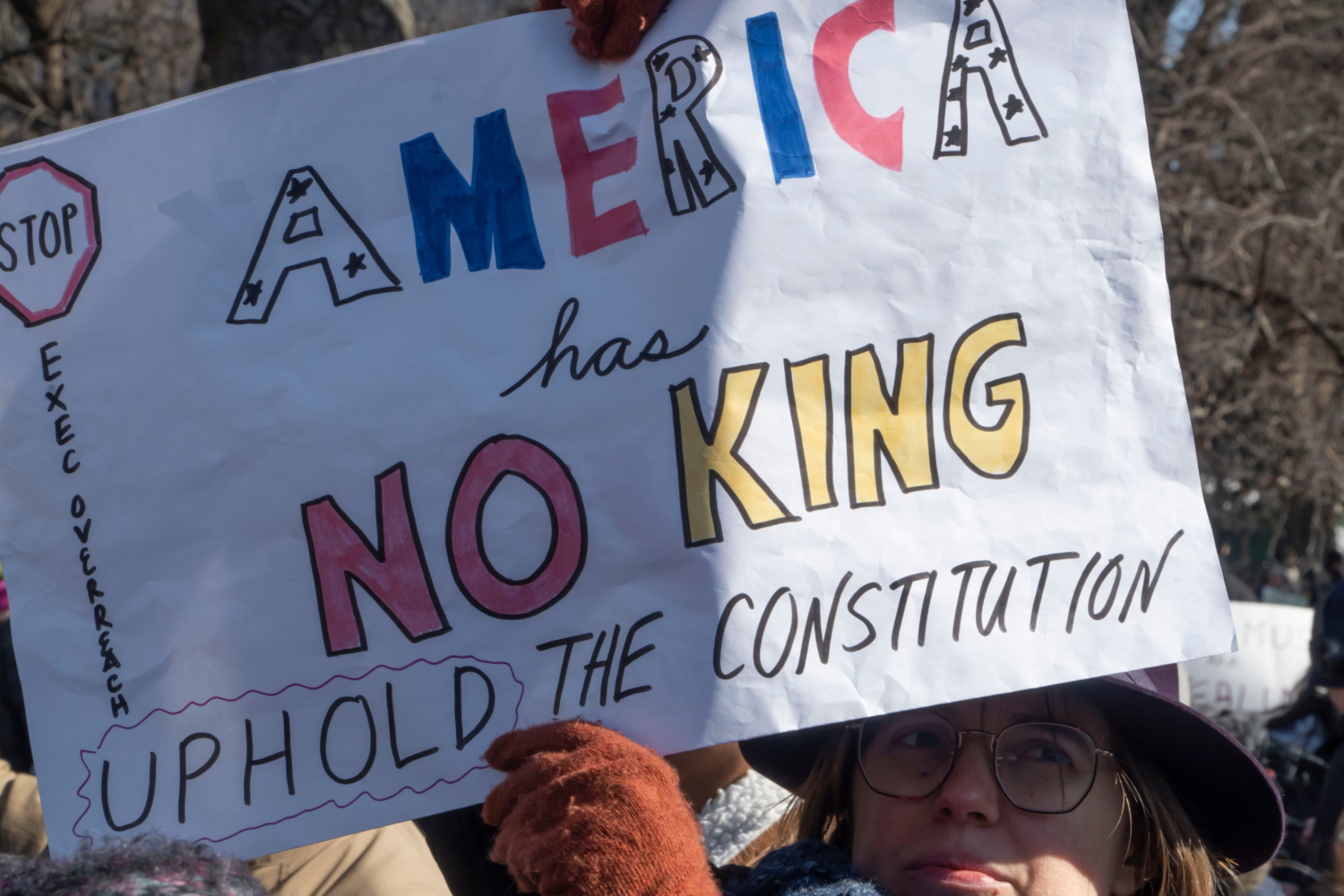
Photo by: John Senter/UCG/Universal Images Group
By Sarah Sicard
The US military’s oath of enlistment serves two primary purposes: ensuring troops’ unwavering loyalty to the Constitution and binding them to the armed forces’ commander-in-chief—the president.
Never before in American history have those two pillars been so at odds.
Have US presidents engaged in unpopular military actions? Certainly. Consider the Forever Wars in Afghanistan and Iraq or the decades of fraught conflict in Vietnam. But now, we are on the precipice of something else entirely thanks to a president who fancies himself a king and the troops’ oaths of office as unwavering fealty.
On Apr. 7, President Donald Trump posted an explicit threat of Iranian genocide to Truth Social.
A whole civilization will die tonight, never to be brought back again. I don’t want that to happen, but it probably will. However, now that we have Complete and Total Regime Change, where different, smarter, and less radicalized minds prevail, maybe something revolutionarily wonderful can happen, WHO KNOWS? We will find out tonight, one of the most important moments in the long and complex history of the World. 47 years of extortion, corruption, and death, will finally end. God Bless the Great People of Iran!
If this is the path he chooses, he “probably will” use the hammer of the US military to carry it out. And now, military leaders in the Pentagon down to the infantry troops at the front lines will need to decide if they will serve a king or the US Constitution.
That Constitution creates a system where no one, including the president, is above the law. Though the president is commander-in-chief, that authority is constrained.
The US military is built on a principle that feels almost quaint in today’s political climate: civilian control, bound by law. Troops don’t get to pick and choose their missions based on their morals. But they also aren’t automatons. The fabric of our military is woven by invisible threads, particularly the trust that lawful orders will remain lawful, and that the president executing them understands that.
Trump, however, is asking this trust—which goes all the way back to our nation’s first commander-in-chief, George Washington—to turn a blind eye. He is unraveling it. There is profound irony in the fact that our military was formed 250 years ago to fight a king who demanded exactly this kind of submission when we were his subjects rather than citizens with self-determination. Today, it is constitutional self-determination that we require from our military.
Modern troops are more educated, connected, and politically aware than at any point in US history. Yet, their core expectations remain unchanged since the Constitution was ratified in 1788. They are to execute lawful orders, refuse unlawful ones, and do so without turning the chain of command into a constitutional crisis.
While this president blurs the line between loyalty to the Constitution and loyalty to the commander-in-chief, one thing is clear: genocide is a war crime. It is murder. An order for “A whole civilization [to] die tonight, never to be brought back again” is, point blank, unlawful.
American troops are bound by the Geneva Conventions (1949), the War Crimes Act (18 U.S.C. § 2441), the Genocide Convention Implementation Act (18 U.S.C. § 1091), and the Uniform Code of Military Justice, all of which prohibit war crimes, genocide, and the unlawful targeting of civilians. Any order against these principles cannot and should not be carried out, regardless of who gives it.
Understanding these laws means recognizing that loyalty to the uniform is not about allegiance to an individual, but to the ideals and the guiding document that predate their service and are meant to survive long after any conflict ends.
The strength of the US military lies not in the number of its troops, the power of its tanks, the size of its bombs, or the depth of its unquestioning obedience. It comes from disciplined, lawful service within a framework designed to outlast any one moment, conflict, or leader—especially one who wants to preside over troops like a king.
Sarah Sicard is COURIER Newsroom’s deputy political editor for states. Prior to this role, she was an award-winning military journalist with a decade of experience covering military culture and conflicts in Gaza, Ukraine, and Afghanistan.
Andrea Levere: Why far-right philanthropy keeps winning

By Andrea Levere
In early 2026, news broke that California billionaires were planning to launch a $500 million fund to reshape the state’s politics, pushing back against popular initiatives like a proposed billionaire tax. What’s most notable about this proposed fund is not its size, but its design. Supported by its own investment returns, the fund is not tied to a particular campaign, but instead will operate in perpetuity, providing the ultrawealthy with a year-round, consistent presence in California politics.
This endowment-like approach understands something essential about building power: Effecting true political change requires consistent, patient work, rather than reactive campaigns that ebb and flow with election cycles. The complicated infrastructure of political advocacy cannot be constructed overnight.
Far-right and anti-democracy philanthropists have intuitively understood this fact for decades, providing multi-year, unrestricted support to build institutions that can weather political cycles and pursue long-term change. Meanwhile, pro-democracy funders – committed to core American values like freedom of speech, equal treatment under the law, and the right to vote – are more likely to offer short-term, restricted support for specific projects and predetermined outcomes.
In short, far-right philanthropists are giving with more abundance, trust, and patience – and this structural advantage is quietly reshaping American democracy.
Consider two additional examples: In 2023, the Heritage Foundation (architect of Project 2025) received $25 million over five years from a family that has been supporting the organization for nearly half a century. Edward Blum, the conservative activist who successfully challenged affirmative action, has described receiving grants from foundations and donor-advised funds (DAFs) “without any kind of a contractual agreement.“
This type of long-term, unrestricted funding that leaves nonprofits with abundant cash on hand – known as enterprise capital – is precisely what is needed to maintain the infrastructure necessary for effective advocacy and narrative change. Enterprise capital enables advocacy organizations to make strategic hires, invest in technology, and do the patient, consistent work of building political movements. Perhaps most importantly, this trust-based funding approach gives advocates on the ground the ability to shape strategies as they see fit, rather than being forced to align with prescriptive ideas from donors.
The far right has used enterprise capital to build a powerful ecosystem of think tanks, astroturf groups, legal networks, and media platforms that help them win even when their positions are unpopular. This approach helps explain seemingly paradoxical outcomes in American politics. “Progressive” positions often command majority public support on issues like raising the minimum wage, health care access, and abortion, yet conservative movements have achieved disproportionate political influence.
Organizations advocating for pro-democracy and social justice issues are nearly 30% less likely to receive flexible funding compared to those who are anti-democracy, such as election deniers and anti-voting rights groups, and more than twice as likely to receive solely project-based support. Short-term funding traps advocacy groups in the nonprofit starvation cycle, forcing them to do more with less and divert precious resources to prioritize constant fundraising over mission-critical work.
The consequences of short-term, restricted funding have played out time and again for pro-democracy organizations working on voting rights and other critical issues. For instance, Black Voters Matter helped turn out millions of voters to win the 2020 election – but reported that “resources dwindled and investment dried up” heading into the 2024 cycle, with donors failing to recognize the importance of year-round funding to build trust with voters. The Carnegie Corporation of New York reported that one of its grantees working on voting issues saw a 40% drop in funding in 2021 compared to 2020, despite the fact that assaults on voting rights do not neatly coincide with election years.
Without consistent funding, these groups must operate with bare bones resources in offseasons and attempt to rapidly scale during campaigns. While pro-democracy organizations scramble to regroup and switch gears to serve funders’ latest interests, far-right groups are afforded the luxury of staying the course – focusing on the consistent, year-round work that changes minds and wins political battles.
The good news is that some pro-democracy funders are already demonstrating a better approach. Democracy Fund, for example, should be lauded for its commitment to significantly increase the proportion of its grants that are larger, multi-year, and unrestricted. Through efforts like 2024’s All by April campaign, the foundation is working to shift funder behaviors away from “boom and bust” giving, encouraging earlier and more long-term funding to nonprofits working in the election space.
That said, we will need to see a far more sweeping change across the philanthropic sector for pro-democracy organizations to dig out of the hole left by past funding deficits. Building robust institutions requires the kind of financial foundation that only enterprise capital can provide.
So for any funders who are concerned about the future of America, the path forward is clear: Embrace enterprise capital – unrestricted, multi-year funding that strengthens nonprofits’ balance sheets. Philanthropy has created the world we live in today. We must fund differently if we wish to create a better tomorrow.
Andrea Levere is CEO of Capitalize Good, a social enterprise working to disrupt philanthropy by expanding access to “Enterprise Capital” – unrestricted, multi-year funding that strengthens nonprofits’ financial resilience and social impact.
Jesse Ferguson: One Year Later — How Trump Lost His Superpower

By Jesse Ferguson
Certain moments undercut the very rationale of a Presidency.
April 2, 2025 will be remembered as Trump’s moment.
That was “Liberation Day”—the day Trump launched his sweeping tariff agenda, promising to make America wealthy again through the power of his deal-making genius. For years, Trump maintained an extraordinary advantage on economic issues. Even when his overall approval ratings sagged, voters trusted him on the economy by double digits. It was his superpower, built over decades of branding from “The Apprentice” and reinforced throughout his first term and 2024 campaign. Even when people might not have liked him personally, they believed he knew how to create prosperity.
Then came the tariffs. And with them, the receipts.
One year later, Trump’s economic advantage has evaporated. His approval ratings on the economy are now underwater—net negative by more than 20 points, according to Navigator Research polling. Americans aren’t debating trade policy in the abstract anymore. They’re looking at their grocery bills, their credit card statements, their family budgets. And they’re angry.
In a recent ad from Opportunity Wisconsin, a woman named Deb from Mount Pleasant walks through her local grocery store tallying the cost of making her family’s famous lasagna. Tariffs have made it unaffordable.
This is what Trump’s tariffs look like in real life. Not in economic white papers or trade negotiations, but at the dinner table, in the everyday decisions families make about what they can and cannot afford.
The numbers tell the story. According to the Joint Economic Committee, the average American family will pay more than $2,500 in tariff costs in 2026—up from $1,744 last year. 81% of voters report that grocery prices have gone up. 73% say imported goods cost more. 72% have seen their electricity bills rise. The New York Federal Reserve found that consumers bear nearly 90% of the tariff burden—94% in the first eight months of 2025. This isn’t a Democratic talking point. It’s literally in the receipts.
And then came the Supreme Court ruling. In a decision that shocked the political establishment, the Court struck down the bulk of Trump’s tariff agenda as illegal—finding that the president had exceeded his constitutional authority. 62% of Americans agreed with the Court’s decision. The tariffs weren’t just unpopular. They were unlawful.
And Trump immediately moved to reenact them.
This creates an extraordinary opportunity for Democrats. But only if they get the message right.
First: Democrats must focus relentlessly on real costs, not theoretical trade policy. Don’t talk about supply chains or comparative advantage or global economic stability. Talk about the cost of Deb’s lasagna. Talk about the $2,500 coming out of family budgets. Talk about car repairs, construction materials, children’s toys, and electricity bills. Make it tangible. Make it personal. Make it impossible to ignore.
Second: leverage the Supreme Court ruling to demand that the money be returned—to consumers, not corporations. Polling shows that 72% of voters believe tariff refunds should go to the people who paid higher prices, not the businesses that paid the import taxes. This includes Trump voters by a 36-point margin. The framing is simple: Trump took money illegally. The Court said so. Now give it back to the families who couldn’t afford to lose it in the first place.
Third: tell real stories from real people. Stories connect with voters in ways statistics alone cannot. In fact, a Stanford professor has found that stories are 22x more memorable than facts.
The political impact is already visible. Democrats are winning in unlikely places—including flipping state legislative seats in Trump’s own backyard near Mar-a-Lago. Voters are connecting their economic pain directly to Trump’s policies.
For years, Trump’s opponents struggled to dent his economic credibility. But tariffs changed the equation. They made the consequences immediate and undeniable. Every trip to the grocery store became a reminder and every family budget became evidence.
Trump gave away his superpower. He revealed the betrayal.
But the window won’t stay open forever. Trump is a master of narrative rehabilitation. He’ll find scapegoats, change the subject, create new distractions. But right now—one year after Liberation Day—the receipts are real, the pain is fresh, and voters are looking for someone to fight for them. He’s made life harder and more expensive.
If we do it right, what was once his superpower will now be his kryptonite. And, more than that, people might actually start to think we give a shit about them in the process.
Jesse Ferguson is a longtime Democratic strategist having advised major candidates, causes and campaigns.
Joseph Geevarghese: Democrats Who Fund Trump’s War Should Expect Primaries

By Joseph Geevarghese
In the opening days of President Trump’s war with Iran, many Democrats struck the right tone. They warned that Trump could not drag the country into another costly war without congressional oversight and backed legislation invoking the War Powers Act to constrain the administration’s authority.
But the question now is whether that opposition was about style or substance.
Was it merely a procedural objection about how the war began or a moral objection to the war itself?
Congress will soon answer that question when it votes on whether to fund the war. And for Democrats, that vote will determine whether the party intends to function as real opposition or simply speak out against Trump’s war while simultaneously financing it.
Opposing a war rhetorically while voting to bankroll it is not opposition. It is performance.
Across the Democratic base, patience with that performance is already wearing thin. And that frustration is already shaping the early contours of Democratic primaries and the broader electoral cycle.
In Illinois’s heated Democratic Senate primary, Lt. Gov. Juliana Stratton and Rep. Robin Kelly pledged during a televised debate that they would oppose additional funding for Trump’s war in Iran. In Hawaii, a Democratic challenger is pressing Rep. Ed Case to take the same position, reminding voters that after supporting the Iraq War, he now has “a chance to get it right.”
These are not isolated moments. They are signals of a larger shift across the Democratic Party’s grassroots and its electorate.
For voters, this comes down to a simple test: if you oppose the war, don’t fund it.
Polling already shows that public opinion is turning against the war, particularly among independents who often decide national elections. That should present a political opportunity for a party eager to define itself as a genuine alternative to Trumpism.
But that opportunity will evaporate quickly if Democrats retreat into procedural objections while continuing to fund the war itself.
The cost alone should force a moment of reckoning.
In a closed-door briefing this week, Pentagon officials told senators that the first six days of the Iran war cost more than $11 billion.
Six days. Eleven billion dollars.
At a time when voters are struggling with rising rents, crushing health care bills and stagnant wages, Washington suddenly has limitless funds for war while claiming there is no money to raise wages, lower housing costs or expand health care.
That contradiction is impossible to ignore.
After two decades of catastrophic wars in Iraq and Afghanistan, Americans have grown deeply skeptical of military adventurism and the political interests that sustain it. Voters today are far more concerned with affordability and economic stability than another open-ended conflict abroad.
Meanwhile, the military industrial complex is thriving.
Within days of the first strikes, the stock prices of major defense contractors surged as investors anticipated expanded weapons production and new Pentagon contracts. Companies like Lockheed Martin, RTX and Northrop Grumman stand to reap billions from a prolonged war.
Long before Big Tech monopolies and private equity landlords became symbols of modern oligarchy, the military-industrial complex perfected the model of extracting public wealth through permanent conflict.
President Dwight Eisenhower warned Americans about this danger in his 1961 farewell address, cautioning the nation to guard against the “unwarranted influence” of a permanent military establishment intertwined with powerful contractors.
More than sixty years later, that warning feels prophetic.
In his own farewell address last year, President Joe Biden warned that the United States now faces “a dangerous concentration of power in the hands of a very few ultra-wealthy people,” an emerging oligarchy capable of distorting democracy itself.
War has always been one of the oldest engines of that oligarchic power.
For months now, Democrats have attempted to present themselves as a unified opposition to Trump’s economic policies and increasingly authoritarian politics. In many respects, that unity has been welcome. The country needs a credible counterweight to the MAGA agenda.
But unity is not measured by press releases.
It is measured by votes.
Democrats who claim to oppose Trump’s war but ultimately vote to fund it should expect primary challenges. That is not a threat. It is a political reality.
Across the country, a growing anti-oligarchy sentiment is animating the Democratic base and driving the energy of the party’s voters. They want a Democratic Party that confronts the concentration of wealth and power shaping American politics, not one that quietly accommodates it. And they increasingly want a party that is willing to stand as a true opposition when the stakes demand it.
Votes like this define political parties. And for Democrats, the vote to fund Trump’s war will answer a simple question: Will they oppose the war in words or will they oppose it in power?
Because voters are paying attention. And those who choose the former should not be surprised if they soon find themselves looking over their shoulder in a primary.
Joseph Geevarghese is the executive director of Our Revolution, the grassroots political organization born out of Bernie Sanders’s 2016 presidential campaign.
Hannah Fried and Francisco Aguilar: Don’t Ignore the Threats to Our Vote

By Hannah Fried and Francisco Aguilar
When Americans hear our leaders talk about a federal takeover of elections, pushing laws at the federal and state levels that prevent eligible Americans from voting and change the outcomes of elections, or revisit old lies about the 2020 election, it can sound abstract—like inside baseball for political junkies or someone else’s problem.
But this kind of rhetoric has serious, real-life consequences that may be far closer than we think. The truth is, the people pushing these ideas are testing the ground right now, dropping comments piece by piece to see what they can get away with and how much resistance they will face.
In January, various media reported that President Trump “regretted not ordering the National Guard to seize voting machines in swing states after his loss in the 2020 election.” Soon after, Trump mused that “we shouldn’t even have an election.” In February, he said members of his party should “nationalize” the voting process, and the White House press secretary took it even further, saying she “can’t guarantee” that ICE won’t be near polling locations in November. Then there was the State of the Union address, where the president pushed the Voter Elimination Act (“SAVE America Act”) in an attempt to seize more power and control our elections before we even cast our votes. Most recently, the Trump administration subpoenaed election information from the Arizona State Senate related to debunked 2020 election conspiracy theories.
These were not offhand comments or idle frustrations. They were a signal. A test. A warning shot meant to normalize something that is flat-out illegal and deeply dangerous.
What people making these comments are really trying to do is take away our voices and stop our votes from counting. They muddy the waters with conspiracy theories and lies, all in an attempt to cast doubt on how our elections are run. It’s an effort to disempower and vilify hardworking local and state elections officials, nonpartisan civil servants focused on ensuring our elections are free and fair.
Let’s be absolutely clear about something that should not be controversial: no American president, governor, or military force gets to decide which votes count or whether elections happen.
Elections are run by state and local officials, not by politicians who are unhappy with the outcome or have a vendetta against those who do not support them. The systems in place exist to protect all of our votes and to keep people from manipulating the results. Any effort to threaten these systems, including seizing or interfering with voting machines, ballots, or other materials, isn’t about “safety” or “confidence,” it’s about overriding the will of the people in a desperate attempt to hold onto or gain power.
That clarity matters because these kinds of baseless claims thrive in confusion. When powerful figures float illegal ideas without immediate pushback, they create space for intimidation, chaos, and abuse. Even entertaining the notion invites copycats, pressure campaigns, and threats against election workers, who are ordinary, hardworking Americans just trying to do their jobs.
We’ve already seen how lies about the 2020 election led to harassment, resignations, and violence.
The consequences of undermining elections are not theoretical. These threats make it harder to make our voices heard on issues like affordable housing, good jobs, lower grocery prices, accessible healthcare, and strong public schools. Communities lose leverage. Accountability disappears. And the people who feel it first are working families already stretched thin.
These attacks also carry real and immediate costs. Conspiracy theory-driven efforts to seize or investigate voting machines force states and counties to divert millions of dollars away from schools, roads, and public services just to keep elections running. After a partisan audit in Arizona found no evidence of misconduct in the 2020 election, officials were forced to replace the compromised voting equipment at a cost of nearly $3 million. That meant delays, confusion, and threats directed at local officials simply for doing their jobs.
This is not politics as usual. It is an extreme abuse of power and a direct threat to our constitutional system. Using the military to interfere in elections is something Americans have long condemned abroad. We cannot shrug off suggestions at home.
So what is required now is not hand-wringing; it is action. Election officials must clearly and publicly state that they will not comply with illegal demands—including those from federal agencies—for access to the voting equipment on which tens of millions of Americans will cast their ballots this year. Governors, secretaries of state, attorneys general, and courts must hold the line and protect voters before a crisis, not after. State legislatures and Congress should strengthen protections for access to the ballot and the administration of our elections, and ensure that every citizen can cast a ballot and that every eligible vote is counted. And the rest of us must keep showing up.
Democracy survives when it is under threat because people come together. That is the collective obligation on all of us in this moment.
Hannah Fried is the co-founder and CEO of All Voting is Local, a nonpartisan organization that fights on the ground in eight states for free and fair elections. A former voter protection attorney who worked on numerous political campaigns, Hannah also spent several years in federal government service.
Francisco “Cisco” Aguilar serves as Nevada’s Secretary of State. As Secretary, he is focused on modernizing, innovating and building transparency in the office. Prior to being elected, Secretary Aguilar served twelve years as General Counsel for Agassi Graf, the management company for Andre Agassi and Stefanie Graf, and the Andre Agassi Foundation for Education. Secretary Aguilar is also the Founding Chairman of Cristo Rey St. Viator High School, which provides an innovative workforce development program in one of Las Vegas’ most vulnerable neighborhoods.
Ashley Shelton: The Senate Must Reject Mullin’s Nomination to Protect FEMA from Further Destruction

By Ashley Shelton
After a year of catastrophic mismanagement, mass firings, and dangerous politicization, the Federal Emergency Management Agency stands on the brink of collapse. Communities across America that depend on federal disaster assistance are watching as the Trump administration systematically dismantles the agency designed to protect them.
Now, with the nomination of Senator Markwayne Mullin to lead the Department of Homeland Security and FEMA, the Senate faces a critical choice: reject this nomination and demand independence for FEMA, or allow the agency to become another casualty of political games while American families pay the price.
The crisis at FEMA didn’t begin with Mullin’s nomination—it accelerated under Department of Homeland Security Secretary Kristi Noem’s disastrous leadership. Since assuming her position last year, Noem slashed 20% of FEMA staff, leaving the agency woefully unprepared for the next emergency. And internal planning documents reveal the administration’s plan goes much further: possibly cutting more than 11,500 employees from FEMA’s workforce of approximately 23,000—a staggering 50% reduction that would gut the agency’s capacity to respond to disasters.
Meanwhile, a sweeping freeze on FEMA staff travel has prevented disaster response personnel from deploying to communities facing active wildfires and ongoing hurricane recovery, effectively abandoning Americans in their moment of greatest need.
Beyond the workforce cuts, Noem quietly dismantled critical programs that helped communities build resilience, train emergency managers, and plan for catastrophic events. These state resiliency programs representing proactive disaster preparedness are the kind of forward-thinking approach that saves lives and reduces recovery costs. Their elimination leaves communities more vulnerable than ever.
The alarm bells are ringing from every corner. Former FEMA officials and whistleblowers have publicly condemned Noem’s leadership as “catastrophic” and warned that her approach is “not a feasible way to protect the United States against disasters.” Many congressional leaders have raised urgent concerns that FEMA workforce cuts leave communities dangerously vulnerable during peak disaster season, with some lawmakers going as far as to demand Noem’s resignation well before the end of her tenure.
This is the agency Senator Mullin has been nominated to lead, and his record makes clear he will only accelerate its destruction.
Mullin’s hypocrisy on disaster assistance is particularly striking. He represents Oklahoma, a state that has received more federal disaster aid approvals than any other in the past two decades. His own constituents have relied on FEMA support to recover from devastating tornadoes and severe weather events that have become increasingly frequent and destructive as climate change intensifies. Yet in 2024, Mullin voted against critical FEMA funding, even as Oklahoma communities depended on the very federal assistance he sought to deny others. This dangerous political opportunism that puts lives at risk.
His nomination sends an unmistakable message: the administration views FEMA not as a critical public safety agency protecting Americans from disasters, but as another tool for political control and partisan warfare. This approach is catastrophic, particularly in this era of unprecedented climate-related disasters.
The logical response would be to strengthen FEMA’s capacity, increase its resources, and ensure professional, non-political leadership focused solely on saving lives and rebuilding communities. Instead, the Trump administration is doing the opposite and systematically weakening the agency while nominating a senator whose record demonstrates he will prioritize political loyalty over disaster preparedness and public safety.
Mullin’s confirmation would guarantee that FEMA remains trapped in the chaos that has defined the past year, unable to fulfill its mission while communities across America face mounting threats.
FEMA simply cannot protect Americans while remaining under political control at the Department of Homeland Security. The agency needs independence, stability, and leadership focused on disaster preparedness, response, and recovery.
The Senate has the power to prevent further damage by rejecting Mullin’s nomination and demanding that FEMA become an independent, cabinet-level agency removed from political manipulation.
Ashley K. Shelton is the Founder, President and CEO of the Power Coalition, a statewide 501c3 table in Louisiana. She is a Senior Fellow with Organizing Resilience bringing her disaster relief, recovery and resilience experience to inform a better way forward by centering those affected by disasters and focusing on a full recovery. Mrs. Shelton was the Vice President of Programs at the Louisiana Disaster Recovery Foundation (LDRF), where she managed their system of integrated programs to create a better Louisiana for all in the aftermath of Hurricanes Katrina and Rita.
Denny Carter: Almost Everyone Loves DEI Now

By Denny Carter
The way Trump regime officials tell it, and the way mainstream media outlets repeat it – sometimes verbatim – you’d think the question of whether the United States should promote diversity is precisely a 50-50 issue. You’d think there are exactly as many Americans who vehemently oppose diversity as there are Americans who support the maintenance of a multicultural democracy.
You would be wrong to believe this reflects reality in any way, if the actual numbers are to be believed. There is nothing close to a durable American constituency for tearing down Diversity Equity and Inclusion (DEI) programs and replacing them not with meritocratic systems, but with straight up in-your-face white supremacist retrenchment.
The constituency for the regime’s appalling AI-powered attack on diversity in the ranks of government agencies, the military, and academia is, in fact, vanishingly small — the kind of fringe that can be ignored if politicians want to ignore it.
Beyond the chinless Elon Musk fanboys posting racist memes on X from their mother’s basements and commanding Grok to make them a digital girlfriend – the only kind of woman that doesn’t find them repulsive – there isn’t an appetite for taking a hatchet to diversity efforts as some kind of solution to whatever ails the nation.

Fewer than two in ten Americans surveyed by The Economist and YouGov in late February said bolstering diversity in the US makes the country a “worse place to live.” Not even a quarter of white folks said diversity would be a detriment to the country, and nearly seven in ten self-identified independents said increasing diversity would make the US a better place or not make much of a difference.
So-called “non-MAGA” Republicans, whatever that means, are cool to the regime’s flailing efforts to kill DEI, which have gone as far as firing high-ranking women and Black people in the military at the behest of fascist online posters who have directed the regime’s actions since it took power in January 2025. While some 2025 polls found more Americans buying into the wretched idea that diversity efforts had gone too far, the February 2026 data suggests a good chunk of those people soured on anti-DEI politics after watching Republicans’ attacks on diversity play out. The viciousness with which the regime has sought to dismantle diversity may have planted the seeds of Woke 2.0, which is more clear-eyed and angrier than Woke 1.0.
Back to The Economist/YouGov findings. Explicitly stating a more diverse US makes the country a worse place is an extraordinarily loaded position and tells me a few things about the respondents. They are textbook white supremacists in that they believe in the genetic superiority of the white race and their worldview is tragically anchored in hierarchies of oppression – the soul-corroding idea that if I’m not atop that hierarchy, my enemy will be. They have bought into the right-wing unreality in which civil rights have gone “too far” and now constitute systemic discrimination against white Americans.
This is how you get an Education Department secretary who says with a straight face that she will fight for equal treatment for all American students by dismantling DEI initiatives in public schools. Within this sordid right-wing unreality – their own invented world shaped and reinforced through their powerful social media media machine – white students are the ones facing repression today. This is one example of many from the second Trump term, and thankfully a federal judge recently saw through this bad-faith attack and slapped down the Education Department’s covert, racist directive.
This fake reality is also why the regime’s U.S. Equal Opportunity Employment Commission – a body charged with enforcing laws that make it illegal to discriminate against a job applicant or employee – is now asking white Americans to file complaints against companies that hired a person of color over them. Under the sheen of caring about equity and inclusion, the right-wing hacks who work for the Trump regime pretend to be freedom fighters for the dispossessed – in this case, white dudes forced to compete for jobs (and status) with women and people of color. They even use the language of civil rights as cover for their hideous little plans, hoping, I suppose, that shredding diversity initiatives across the country will gain wider acceptance.
These vile anti-diversity efforts, however, have not seen anything resembling popularity, as The Economist found in striking numbers. That four in ten self-identified MAGA respondents agree that diversity makes the country a worse place to live is unsurprising; that it’s not seven or eight out of ten highlights how small the constituency that backs the regime’s half-assed attempts to rewrite American history actually is.
Removing a plaque commemorating the struggle of enslaved people – only to have a judge immediately demand its restoration – is not going to undo generations of progress, however slow and painful that progress has been. It might give regime officials a dopamine rush and draw praise from loveless weirdos on X, but it does nothing to achieve their overarching goal of repealing the achievements of the Civil Rights movement, which they consider a historical mistake in need of correction.

The Economist/YouGov polling revealed a desire among right-wing Americans to move beyond the push to make the United States a fairer and freer place for all. More than half of Republican respondents said Martin Luther King, Jr.’s dream of racial equality and equity has already been achieved. A mere 12 percent of Republicans said it had not been realized. Black and Latino respondents, as you might imagine, were much less certain.
If you, like me, are white and have lots of white family and friends, you’ve probably been told – at a safe distance from mixed company – that slavery and Jim Crow and systemic discrimination belong to the past, that it has been dealt with, that we can and should move on from the messiness of righting historical wrongs. The laziness of this sort of thinking is designed to be politically convenient.
A society that collectively decides racism has been “solved” – that all of those pesky little boxes have been checked – can justify a government and workplaces that side with white guys like me. Bleeding DEI dry requires an acknowledgement that things have been fixed, not just among white people, but among everyone. Without that widespread belief, diversity efforts will survive this blackpilled regime and one day thrive in a nation that has watched what anti-DEI politics look like and not liked it, not one bit.
Denny Carter is the owner of BadFaithTimes.com, which has a twice-weekly newsletter. You can follow Denny on BlueSky at @dennycarter.bsky.social.
Alex Aronson: The Reality of Trump’s Rigged Courts

By Alex Aronson
In February, as you may have heard, the Supreme Court struck down Donald Trump’s tariffs policy. The headlines wrote themselves. The New York Times, for example, heralded the decision as “the Supreme Court’s Declaration of Independence,” positing that “it may prove to be the most important Supreme Court decision this century.”
As if.
One ruling—to overturn a deeply unpopular policy that would have hurt billionaires’ bottom lines and could have damaged Republicans’ chances in the upcoming midterm elections—does not change the overwhelming reality: the Roberts Court is not holding Trump accountable. It is facilitating his agenda. At the same time, Trump’s ongoing effort to pack the judiciary with loyalists is already paying off, with Trump-appointed judges boosting his win rate even in the lower federal courts.
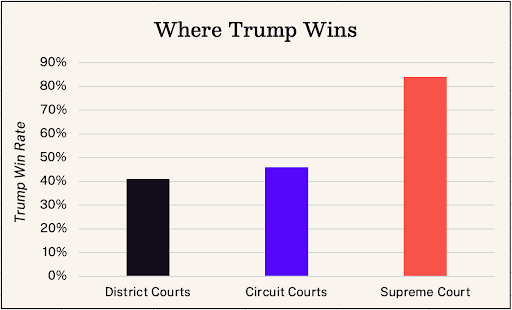
Our updated analysis of 384 federal court rulings involving challenges to Trump administration actions—from immigration raids targeting U.S. citizens to voter suppression efforts to the dismantling of environmental protections—confirms what we’ve seen for years but the liberal establishment has failed to adequately reckon with. While district courts are continuing to function largely as independent legal checks on executive overreach, Trump-appointed judges are substantially more likely to rule in favor of the administration than other Republican appointees. And the Roberts Court has emerged as the administration’s most reliable forum, with its supermajority overwhelmingly greenlighting Trump’s policies and reversing lower-court efforts to restrain the administration’s actions.
Let’s look at the numbers.
In the district courts, Trump loses—badly. Across 245 district court rulings, his administration lost 59% of the time, a staggering rate for the United States government. That includes losses before judges appointed by Republican presidents, who have ruled against him 54% of the time.
But there’s a striking divide within those Republican appointees. Judges appointed by Republicans other than Trump have ruled against the administration in 79% of cases. Trump’s own appointees? They ruled against him in just 31% of cases.
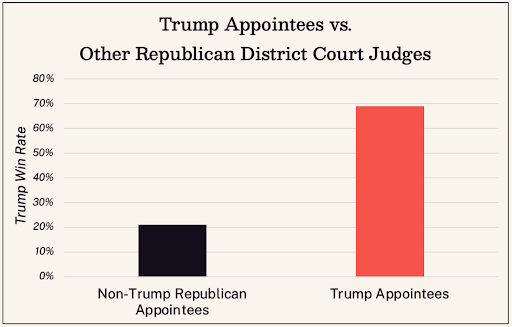
That’s not conservativism. It’s fealty. These aren’t judges applying doctrine in good faith. They are behaving differently from their Republican peers in a way that consistently benefits Trump. The simplest explanation is the correct one: they were selected not for their legal reasoning, but for their loyalty. And they’re delivering.
At the court of appeals level, where confirmation politics have devolved toward brass-knuckles partisanship following Mitch McConnell’s elimination of the circuit court “blue slip”—a procedural tool that once gave senators an effective veto over appointments to circuit court vacancies in their home states—our data reveals a disturbing partisan fracture.
Republican-appointed circuit judges have voted in favor of the administration 87% of the time, while Democratic appointees have voted against it 78% of the time. Again, as reported by The New York Times, Trump’s own appellate judges voted for the administration nearly universally—92% of the time.
But the real story is at the Roberts Court, where, aside from the headline-grabbing tariffs case, the 6-3 Republican supermajority has been Trump’s most reliable judicial ally. Across the 25 rulings we analyzed, the administration won 84% of the time—even including the tariffs case.
Most of these cases came via the shadow docket, where there’s no oral argument, minimal briefing, and often cursory reasoning. These orders are supposed to be—and frequently dismissed as—temporary. In practice, they can cause immediate, irreparable, and widespread harm.
Last fall, for example, when the Court allowed Trump’s directive on race-based immigration detentions to take effect, clearing the way for racially profiled “Kavanaugh Stops,” ProPublica documented what happened next: over 170 U.S. citizens were detained by immigration agents. Some were dragged from their cars. Others were held for days in freezing conditions, in their underwear, denied phone calls to lawyers or family. At least one was tased; another shot.
In another unsigned shadow docket order last year, the Roberts Court greenlit what Senator Elizabeth Warren rightly described as the “greatest theft of personal data in U.S. history,” granting Elon Musk’s DOGE access to all the sensitive data in Americans’ Social Security files. Last month, DOJ acknowledged in court that individuals’ personal data had been disclosed to unauthorized third parties using a non-government server. There’s no putting that cat back in the bag.
It is clear that the U.S. Supreme Court is no longer functioning as a neutral constitutional arbiter or a functional check on President Trump’s dangerous Project 2025 agenda. Instead, it is operating as his enabler-in-chief—and a structural veto on democratic governance.
Of course, the Roberts Court’s pattern of partisan interference is not new. In a series of 5-4 and 6-3 decisions spanning voting rights, reproductive freedom, climate regulation, labor law, gun safety, and more, the Roberts majority has effectively rewritten the Constitution to dismantle the core pillars of 20th-century progress.
Its decisions haven’t merely reversed decades of economic and social compromise and achievement; through rulings enabling unlimited political spending and undermining democratic participation, the Roberts Court has structurally reordered our constitutional system to make future progress impossible.
This latest analysis reinforces that we are hurtling toward a system of “autocratic legalism,” where democracy dies not through military coups but through legal mechanisms that appear legitimate while systematically dismantling popular sovereignty. While litigation can limit the damage, it cannot reverse the tide. Nor can proponents of democracy afford to wait things out. Given the Court’s current 6-3 right-wing supermajority, Republican-appointed justices are projected to control the Supreme Court until around 2065.
So what do we do?
First: Stop pretending the Supreme Court is neutral, or that it will save us.
It’s not, and it won’t. It’s a political institution with immense power, and it’s being used to shield and legitimize a lawless administration. Every shadow docket order should be met with public outrage, not deference.
Second: Stop calling them “conservative.”
Trump’s judges aren’t ruling based on legal doctrine. They’re ruling in lockstep with his agenda, even when other Republicans reject it. That’s not ideology. That’s corruption. Name it.
Third: Tell Congress to fight.
Demand that members of Congress do their job and rein in the Court: enact term limits, enforce an ethics code, strip the Court’s jurisdiction to insulate broadly popular legislation from corrupt judicial invalidation, expand the lower courts to dilute the influence of Trump’s hack appointees. And stop confirming his nominees with bipartisan votes. This isn’t about norms. Norms died when the Court started rubber-stamping abuse of power.
We’re not just in a constitutional crisis. We’re in a corruption crisis. And the Supreme Court isn’t the solution. It’s the heart of the problem. Unless we confront this reality and adjust our strategy accordingly, this will end in a system of competitive authoritarianism legitimized by judicial decree.
It’s time to reclaim our collective power, demand real action from our elected officials, and stop hoping that a small group of unelected politicians in robes will swoop in and save us from autocracy.
Alex Aronson is Court Accountability’s co-founder and executive director. He has served as chief counsel and senior counsel to U.S. Senator Sheldon Whitehouse, managing director of the Institute for Constitutional Advocacy and Protection at Georgetown University Law Center, and an attorney in the Appellate Section of the Civil Rights Division of the U.S. Department of Justice. His commentary has appeared in outlets such as The New York Times, The Washington Post, Politico, The Hill, Rolling Stone, MSNBC, and The Guardian.